When someone sends you the word 'bird' in a text, the most likely meaning depends almost entirely on who sent it and what else is in the message. It could be slang for a woman or girlfriend, a casual nod to a well-known idiom like 'early bird catches the worm,' a symbolic reference to a specific species like a dove or raven, or just a literal observation about an actual bird they saw. The fastest way to know is to check the surrounding words, the emoji, the relationship, and the tone. When someone sends you the word 'bird' in a text, the most likely meaning depends almost entirely on who sent it and what else is in the message. It could be slang for a woman or girlfriend, a casual nod to a well-known idiom like 'early bird catches the worm,' a symbolic reference to a specific species like a dove or raven, or just a literal observation about an actual bird they saw. The fastest way to know is to check the surrounding words, the emoji, the relationship, and the tone. This guide walks you through every realistic scenario so you can decode it in seconds, including the definition of a bird (what does bird mean).
What Does Bird Mean in Text? Slang, Idioms, and Replies

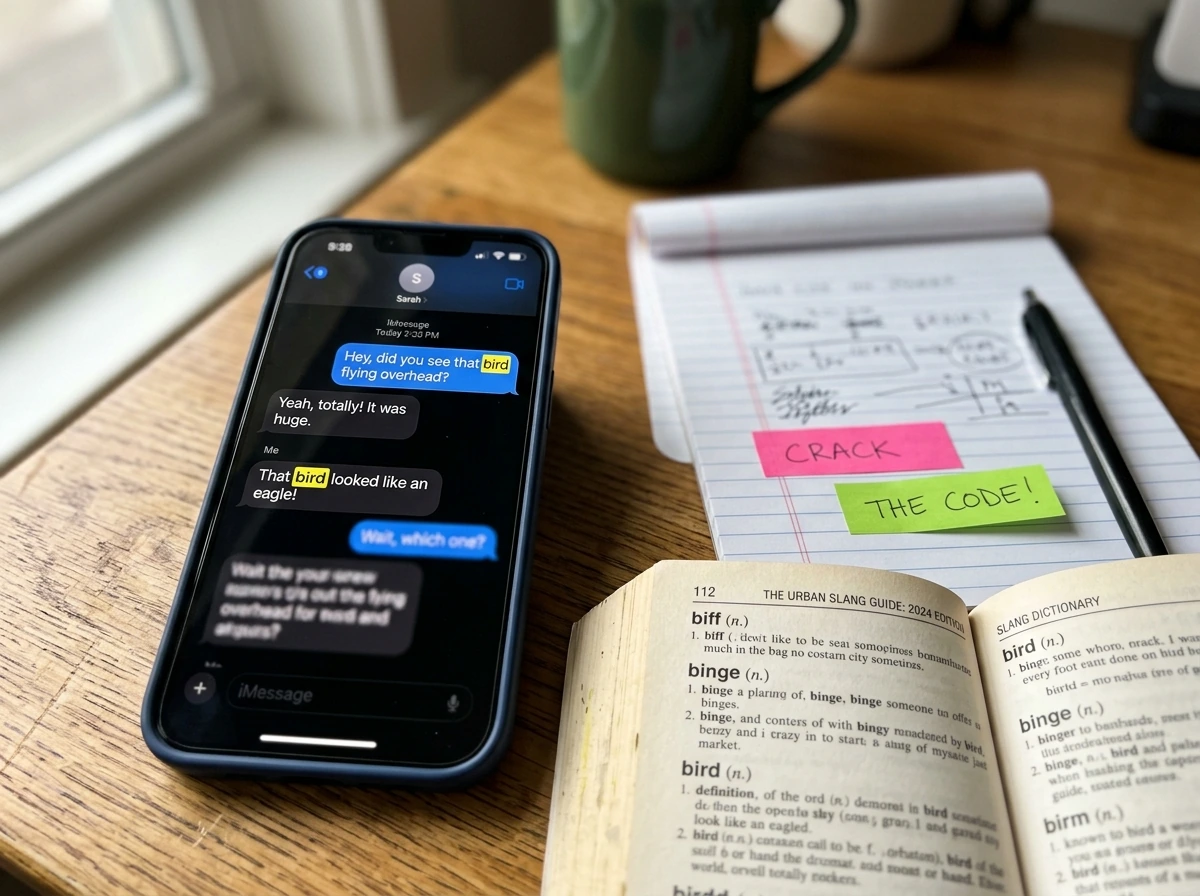
How to identify which 'bird' meaning is showing up in a text
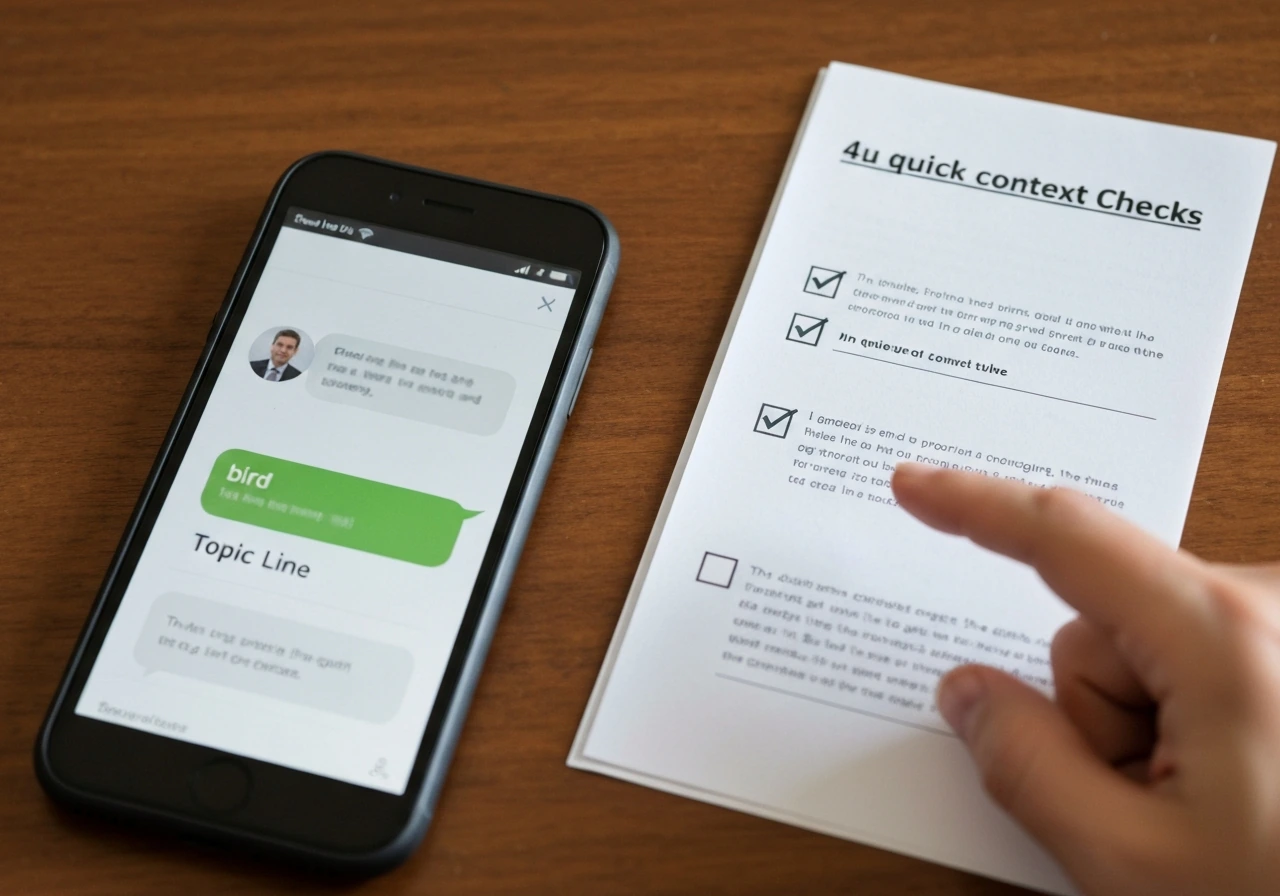
The word 'bird' is one of those terms that can wear a dozen different hats depending on context. If you want the literal starting point, check the definition of a bird alongside these text-meaning clues. Before you overthink it, run through these four quick checks: Who sent it? What's your relationship with them? What are the words and emojis around it? And what were you two just talking about? Those four things will narrow it down almost every time.
If someone was already talking about waking up early, 'bird' is almost certainly part of the 'early bird' idiom. If a British friend or someone from the UK sent it while referring to a person, it's probably slang for a woman or girlfriend. If the conversation was about feelings, loss, or something heavy, and a specific bird species gets named, you're likely looking at symbolic usage. And if there's a bird emoji sitting right next to it, they might just be talking about an actual bird they spotted.
A useful mental shortcut: A useful mental shortcut: slang 'bird' usually refers to a person. Idiomatic 'bird' usually comes attached to a fuller phrase. Symbolic 'bird' almost always names the species (dove, raven, owl). And literal 'bird' pairs with a location or action ('there's a bird on my window sill'). Keep that four-way split in mind and most messages become obvious within seconds.. Idiomatic 'bird' usually comes attached to a fuller phrase. Symbolic 'bird' almost always names the species (dove, raven, owl). And literal 'bird' pairs with a location or action ('there's a bird on my window sill'). Keep that four-way split in mind and most messages become obvious within seconds.
Common slang meanings of 'bird' in messages
In slang, 'bird' covers a few distinct meanings that have developed across different regions and communities. The most widespread one is a woman or girlfriend, a usage that's particularly common in British and Irish English. You'll hear it in UK texts and social media constantly: 'She's a lovely bird' or 'who's that bird he's with?' It's been around long enough that Green's Dictionary of Slang formally documents it as one of bird's primary slang senses.
A second slang use is 'doing bird,' which means serving a prison sentence. If someone texts 'he's doing bird,' they mean the person is in prison. This one is almost exclusively British and typically doesn't show up without some surrounding context making it obvious. You can read more about this specific usage in the related article on what 'doing bird' means if you encounter it.
There's also 'birb,' the intentionally misspelled internet version of bird that's become a soft, affectionate term used in memes and posts about cute or funny birds. Dictionary.com officially recognizes 'birb' as an informal, endearing internet spelling. If someone sends 'what a cute birb,' they're leaning into that playful internet tone, usually accompanying a funny bird photo or video.
- Bird (British/Irish slang): a woman, girlfriend, or attractive person
- Doing bird: serving time in prison (almost exclusively British slang)
- Birb: affectionate internet slang for a cute or funny bird, used in memes
- Bird (US slang): can refer to a middle finger gesture, as in 'flip the bird'
- Early bird: someone who wakes up or arrives early, from the classic proverb
'Bird' as a nickname or flirt/insult (tone and intent)

Calling someone a 'bird' directly, as in 'you're such a bird' or 'hey bird,' sits in a complicated middle zone, so what does it mean to call someone a bird? It can be flirty and affectionate, mildly teasing, or genuinely insulting, and the difference lives entirely in tone and relationship. Between friends who use this kind of banter regularly, 'bird' can be warm and playful. From a stranger or someone who's being dismissive, it can feel reductive or belittling.
If someone calls another person a 'bird' admiringly in a text, like 'she's a proper bird,' that reads as a compliment in most British or Irish contexts, equivalent to calling someone attractive or charming. But if the tone shifts and someone says 'stop being such a bird,' it's leaning toward an insult, implying the person is being flighty, foolish, or overly chatty. Context, punctuation, and your read on the sender's general vibe all matter here.
When 'bird' is used as an actual nickname, like someone repeatedly calling a friend 'Bird,' it's almost always affectionate. It might reference a personality trait (they're always up early, they sing, they move fast), or it might just be one of those nicknames that stuck. The jazz legend Charlie Parker was nicknamed 'Bird,' for example, and that nickname came from his love of fried chicken, not any deep symbolism. Nicknames don't always have grand meanings.
Bird idioms and quotes people often paraphrase in text
People drop bird idioms into texts constantly, sometimes writing the full phrase and sometimes cutting it short and assuming you'll fill in the rest. Knowing the most common ones means you'll catch the reference even when only half of it shows up.
'Early bird catches the worm' is one of the most used. 'blank" rel="noopener noreferrer">Early bird catches the worm' is explained by Dictionary.com as an expression for the person who arrives first having the best chance for success. Cambridge Dictionary defines it as an idiom meaning that being early or proactive gives you an advantage. blank" rel="noopener noreferrer">Merriam-Webster also defines 'early bird' on its own as a noun for someone who wakes up or arrives early. If someone texts 'early bird!' after you mention getting to the gym at 5 a.m., that's the entire message. They're calling you disciplined and proactive.
'A bird in the hand is worth two in the bush' gets paraphrased a lot when someone is advising you to take a sure thing over a riskier option. You might get a shortened version like 'bird in hand, just take the offer.' Same idea. 'Kill two birds with one stone' shows up when someone's pointing out that one action solves two problems. 'Flip the bird' refers specifically to showing the middle finger. 'Free as a bird' means completely unrestricted or liberated. And 'a little bird told me' is used when someone wants to share gossip or information without revealing their source.
| Idiom or phrase | What it means in plain language | Example text usage |
|---|---|---|
| Early bird catches the worm | Being proactive or early gives you an advantage | 'You got there first? Early bird!' |
| A bird in the hand is worth two in the bush | A sure thing now beats a bigger maybe later | 'Bird in hand, just take the job offer' |
| Kill two birds with one stone | One action that solves two problems | 'Let's grab coffee near your office, kill two birds' |
| Flip the bird | Show the middle finger as an insult or expression of frustration | 'I literally flipped the bird at that driver' |
| Free as a bird | Completely unrestricted or unburdened | 'Finished exams, free as a bird now' |
| A little bird told me | Someone shared info but the source stays anonymous | 'A little bird told me you got promoted?' |
Bird symbolism and cultural references (dove, owl, raven, etc.)
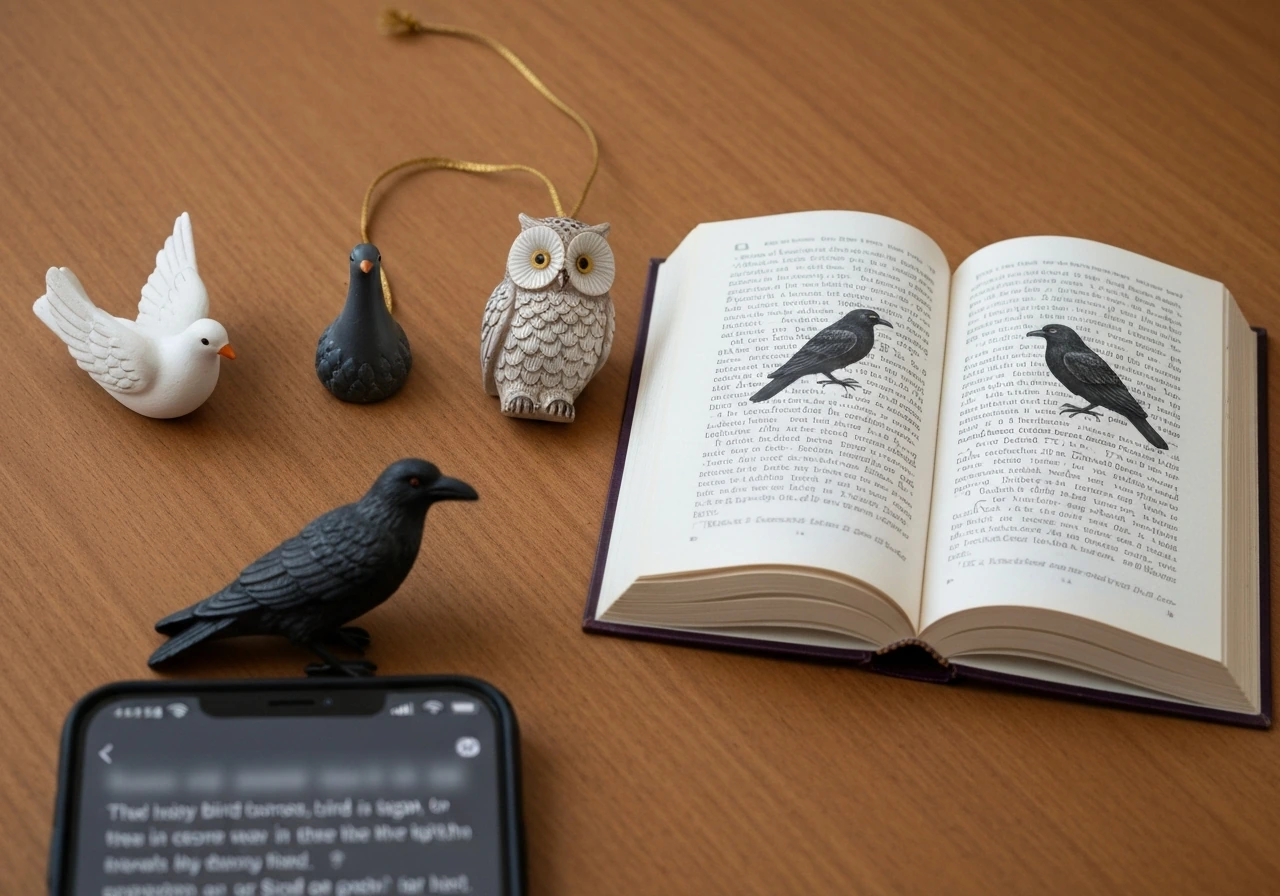
When someone names a specific bird in a text rather than just saying 'bird,' they might be leaning on deep cultural or symbolic meaning, whether consciously or not. This comes up a lot in emotional conversations, creative writing discussions, and references to literature, film, or music.
The dove is the most universally recognized peace symbol, showing up across religions and cultures as a sign of hope, innocence, and reconciliation. If someone references a dove in a heavy conversation, they're almost certainly reaching for that symbolism. The raven carries the opposite weight: mystery, darkness, and often death or bad omens, heavily linked to Edgar Allan Poe's poem 'The Raven.' If someone quotes or references a raven in a text, especially a brooding or poetic one, they're likely nodding to that tradition.
The owl is almost always about wisdom or knowledge in Western culture. Someone calling you an owl or referencing one is usually complimenting your intelligence or noting that you think deeply. In some cultures, though, owls are associated with death or bad omens, so the reading shifts depending on background. The phoenix, while technically mythological, functions like a bird symbol for rebirth and resilience. And the eagle, especially in American contexts, carries strong patriotism and freedom associations.
Literary and pop culture references show up in texts more than you'd expect. Someone might drop 'to kill a mockingbird' into a conversation about injustice or childhood. They might quote from 'I Know Why the Caged Bird Sings' by Maya Angelou to describe feeling trapped or fighting for freedom. The caged bird as a symbol of oppression or longing for freedom is one of the most powerful in American literature, and people reference it in shorthand all the time. If the conversation is about those themes, that's almost certainly what's being invoked.
Ask-and-respond: how to figure it out fast using context cues
If you're genuinely not sure which meaning of 'bird' someone intended, the fastest route is to scan the message for four things: the topic being discussed, the relationship you have with the sender, the tone and punctuation, and any emojis or images attached. Run through those in order and you'll almost always land on the right interpretation.
- Check the topic: Were you talking about time, productivity, or getting somewhere early? That's the 'early bird' idiom. Were you discussing a person? That's likely slang. A difficult emotion or life event? Probably symbolic.
- Check the relationship: A British or Irish contact using 'bird' to describe a person is using standard slang. A poetic or literary friend naming a specific species is reaching for symbolism. A meme-loving friend sending 'birb' is being adorably internet-coded.
- Check the tone and punctuation: Exclamation marks and casual language suggest idioms or slang. Slower, more deliberate sentences with a named species suggest symbolism or cultural reference.
- Check the emoji: A bird emoji (especially a dove or owl) next to the word strongly signals literal or symbolic meaning. No emoji and a conversational tone points toward slang or idiom.
- When still unsure, just ask: A simple 'wait, are you calling me an early bird or what?' keeps the conversation light and gets you the answer without overthinking.
The key thing to remember is that most people aren't sending cryptic messages. If you read the sentence aloud with your best guess at the meaning and it makes sense, you're probably right. The ambiguity usually dissolves the moment you apply even a little context.
Examples and quick translations by scenario
Here are common real-world scenarios with the text someone might send, what they probably mean, and what you can reply. These cover the most frequent uses you'll actually encounter.
| What they sent | What they probably mean | What you can reply |
|---|---|---|
| 'You're such an early bird lol' | You wake up or show up earlier than most people | 'Ha, can't help it, love mornings' |
| 'She's a fit bird' | She's an attractive woman (British slang) | 'Ha, do you know her?' |
| 'Bird in hand, just accept the offer' | Take the sure thing, don't gamble on something uncertain | 'Yeah you're right, I'm overthinking it' |
| 'He flipped the bird at the ref lol' | He showed the middle finger to the referee | 'Classic, what happened next?' |
| 'Free as a bird now that exams are done' | They feel completely free and relieved | 'Same energy, let's celebrate' |
| 'A little bird told me you got a promotion?' | Someone told them your news, they're not saying who | 'Haha who told you that?' |
| 'That raven painting is giving me Poe vibes' | The image feels dark and gothic, referencing Poe's 'The Raven' | 'Totally, very 'nevermore' energy' |
| 'Look at this birb omg' | They found a cute/funny bird photo online (internet slang) | 'SEND IT, that's adorable' |
| 'Doing bird for two years apparently' | Someone is serving a two-year prison sentence (British slang) | 'Oh wow, what happened?' |
| 'Like a caged bird you know?' | Feeling trapped or unable to express themselves freely | 'I hear you, that sounds exhausting' |
Once you start mapping the patterns, it gets fast. 'Bird' in a British or Irish context with a person as the subject is almost always the girlfriend/woman slang. 'Bird' in a phrase fragment is almost always an idiom. 'Bird' attached to a specific species name in a deeper conversation is almost always symbolic. And 'birb' is always internet-cute. Keep those four lanes straight and you'll decode it right almost every time. If you want the quick starting point before you decode tone and context, see what does bird mean and use it alongside the pattern tips here.
FAQ
If someone texts “bird” with no emojis and no other words, what should I assume first?
Treat it as ambiguous until you get context. Start by checking who sent it and whether you have any relationship-based banter, since “bird” is often person slang in British and Irish texting. If it was just a one-word reply, respond with a neutral question like “What do you mean by bird?” rather than assuming flirting or an insult.
How can I tell if “bird” is meant as flirting versus a mild insult?
Look for tone markers that hint at intent: affectionate context (compliment about appearance, “proper,” “pretty,” laughing emojis) usually points to flirting or endearment, while commands or rejection (like “stop being,” “don’t,” “what’s wrong with you”) can turn it into teasing or belittling. If their prior messages are hostile or dismissive, assume it’s not affectionate.
What does “doing bird” mean if I see it once in a chat thread?
It means serving a prison sentence, but it usually requires surrounding context to be intelligible. If you see “doing bird” without any other criminal or legal references, ask a clarifying question, because regional slang can be misunderstood even by people who use it.
Is “birb” only for cute bird photos, or can it be used in serious conversations?
“Birb” is generally intentionally playful and endearing, so it usually signals a light or meme-style tone. If it appears in an otherwise serious argument, it might be an attempt to soften tension, but it can also read as dismissive, so consider how the other person normally uses humor.
When someone says “you’re such a bird,” should I respond with humor?
Only if your relationship style supports banter. In friend-to-friend exchanges, a light comeback can work, but with a stranger, coworker, or someone who seems irritated, humor may escalate the misunderstanding. A safe response is to ask what they mean or to mirror their tone, like “What did I do?”
Can “bird” mean something different in the US or outside the UK?
Yes. The person slang sense (woman or girlfriend) is especially common in British and Irish contexts, so outside those areas it might be literal, idiomatic, or even symbolic. If you are in a different region, don’t default to girlfriend slang unless the sender’s messages consistently match that pattern.
What’s the most reliable way to decode “bird” when multiple meanings could fit?
Use a priority check: (1) topic (are you discussing relationships, waking early, jokes, or emotions), (2) relationship with the sender (partner, friend, stranger), (3) punctuation and capitalization (one-word replies, repeated “bird,” exclamation points), (4) any species name or bird emoji. If more than one meaning still fits, ask for clarification rather than guessing.
Does “a little bird told me” always mean gossip, even if it’s written casually?
Usually yes, it indicates the sender is passing along information they heard indirectly, and they typically want to keep the source hidden. If the message includes urgency or sensitive details, treat it carefully and verify the information through more direct channels before acting.
How should I interpret “flip the bird” in a text context?
It refers to showing the middle finger, so it is a rude or rebellious gesture. In a text, it often comes with frustration or defiance. If you want to de-escalate, a good first step is to address the underlying issue rather than matching the insult, for example “I’m upset too, but let’s talk about what happened.”
What Does Bird Mean? Literal, Slang, and Common Idioms
Meaning of bird: literal animal, slang terms like bird up and t-bird, plus idioms and symbolism cues in context.