Nobody has pinned down a single canonical source for the phrase 'knife blood bird bird up mountain,' and that is actually the most useful thing to know first. This is almost certainly a riddle, lyric fragment, meme caption, or cipher-style line you encountered somewhere specific, and the meaning shifts dramatically depending on where you saw it. The good news is that each word in the phrase carries well-established symbolic weight, so you can decode the most likely interpretation by working through what each piece usually means, then matching that to your context.
Knife Blood Bird Bird Up Mountain Meaning Explained

Marcus Reeves
27 May 2026

What each word is doing in the phrase
Breaking this down word by word gives you the building blocks you need before you can make sense of the whole thing.
| Word | Common Symbolic Register | What It Tends to Signal |
|---|---|---|
| Knife | Violence, cutting, sacrifice, tool of change | Threat, ritual marking, the act of severing or deciding |
| Blood | Life force, sacrifice, consequence, kinship | Stakes are high; something has been lost, given, or claimed |
| Bird (first) | Freedom, messenger, omen, the soul | A creature in motion; often stands for a person, spirit, or signal |
| Bird (second) | Repetition for emphasis, or a second distinct creature | Doubles the bird imagery; could mean a flock, an echo, or two different 'birds' |
| Up | Direction, intention, escalation | Movement toward something; ascent is almost always deliberate here |
| Mountain | Challenge, ascension, spiritual trial, height of power | Either the obstacle itself or the destination; rarely just geography |
The doubled 'bird bird' is the part most people stumble on. It could be a transcription glitch (someone wrote it twice by accident), a deliberate repetition for emphasis or rhythm, or it could literally mean two birds, the way folk riddles sometimes pair creatures to represent different forces in conflict or cooperation.
Which 'bird' is this actually about
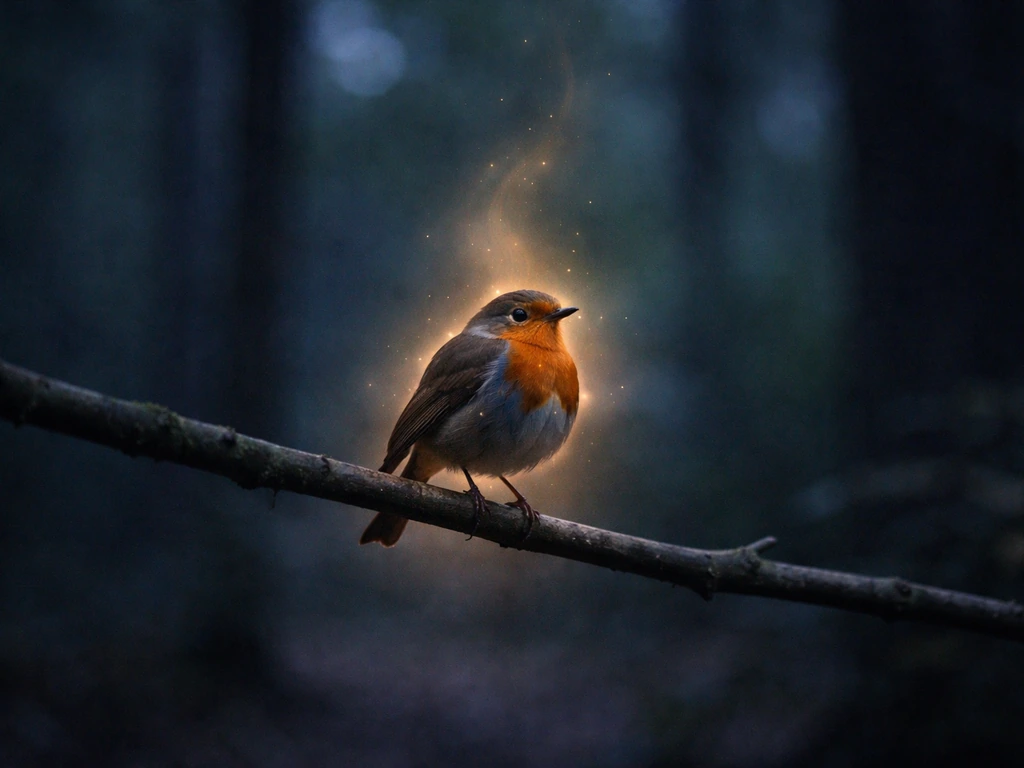
In bird symbolism and slang, 'bird' rarely just means a random winged animal. You need to figure out which register is being used before the phrase makes sense.
Generic bird as soul or messenger
Across a huge range of cultures and literary traditions, a bird paired with blood or a weapon signals the soul leaving the body, a spirit being threatened, or a message delivered at a cost. If the phrase comes from a poem, story, or lyric, this is the most likely reading: the bird is not a specific species but a stand-in for something alive and free that is now in danger.
Named species with omen associations
Some birds carry specific cultural baggage that changes the whole phrase. The “mourning bird meaning” is often related to how certain cultures associate particular birds with grief, death omens, or transformation. Ravens and crows signal death or transformation in Western and Indigenous North American traditions. Owls, particularly in some Indigenous superstitions, are so strongly associated with death that English even coined the word 'deathbird' for certain owl species like Tengmalm's owl.
The Australian bush stone-curlew got nicknamed 'murderbird' because its scream sounds disturbingly human. If someone dropped one of these species names and you are trying to recall whether it was there, that detail matters a lot. [Related phrases like 'murder bird'](https://www. splinter.
com/murder-bird-is-our-ruler-now-1834271799) or what birds mean in the context of death are worth checking if your source feels dark or ominous in tone.
Bird as slang or idiom

In modern slang, 'bird' can mean a person (British English), a woman (older British slang), or even a rude gesture. In certain rap and hip-hop lyrics, 'bird' or 'birds' refers to kilograms of cocaine. If the phrase comes from a song with street or trap influences, the knife-blood-bird combination might be describing violence in a drug context rather than anything symbolic or mythic.
What the knife and blood imagery usually means
Knife and blood together in a phrase are almost never neutral. Here are the most common readings, ordered from most literal to most metaphorical.
- Literal violence: someone or something is physically harmed. If this is a lyric or story fragment, it may be narrating an act of injury or killing.
- Sacrifice: blood drawn by a knife is one of the oldest ritual images across cultures. In mythic or spiritual contexts, this signals an offering or a price paid to gain something (like the right to ascend a mountain).
- Marking or initiation: a knife drawing blood can represent a rite of passage, a covenant, or the moment someone proves themselves. This pairs naturally with 'up mountain' as a trial.
- Metaphorical cutting: the knife is not physical at all. It represents a sharp truth, a decision that cuts cleanly, or a betrayal. 'Blood' then means emotional or relational damage. Folk and indie lyrics use this register constantly.
- Taboo or transgression: the knife-blood pairing signals that a line has been crossed. The mountain ascent that follows could represent the consequence or the escape.
Poets and lyricists have long paired knife imagery with mountain imagery specifically because both carry the idea of sharpness and height: the knife cuts upward, and the mountain demands you cut through difficulty to reach the top. Folk lyrics recorded by bands like Still on the Hill use exactly this combination, with lines about a pocket knife and climbing a mountain appearing in the same breath to describe emotional hardship pushing someone forward.
What 'up mountain' is really saying

The phrase 'up mountain' without an article (not 'up the mountain' or 'up a mountain') is a stylistic choice. It sounds like a fragment, a command, or a translated phrase, which is a clue about the source.
- Literal geography: the bird or person physically moves upward to a mountain. Simple narrative action.
- Spiritual or mythic ascent: mountains in nearly every major tradition represent closeness to the divine, a test of worthiness, or a place of revelation. If the phrase has a ritualistic or religious tone, this reading fits.
- Escalation of stakes: 'up mountain' can signal that the situation is getting harder, higher, more dangerous. The knife-blood imagery establishes violence or sacrifice at the base; the mountain is where it leads.
- Idiom-style shorthand: in some internet meme formats and viral text snippets, compressed non-grammatical phrases ('bird bird up mountain') deliberately strip out articles and verbs to create an oracle or riddle effect. The 'wrongness' of the grammar is intentional.
- Translation artifact: if the original phrase was in another language and someone translated it word for word, 'up mountain' without an article is exactly what you get from several Asian and African language structures. This would explain both the doubled 'bird bird' and the missing articles.
Riddle traditions specifically love the mountain as a final image because it is both an obstacle and a destination. Tolkien's Gollum riddles famously put 'birds' and 'beats a mountain down' in the same breath, showing how deeply embedded this pairing is in the riddle genre. If your phrase came from something puzzle-like, that tradition is almost certainly in play.
Context checklist: figure out where you actually saw this
The fastest way to nail down the meaning is to identify the source. Work through these questions honestly.
- Was it a song lyric? If yes: what genre? Do you remember any other lines? Knife-blood-bird combinations appear in folk, metal, hip-hop, and avant-garde poetry lyrics with completely different meanings in each genre.
- Was it a meme or social media post? If yes: what was the image or video paired with it? Memes often use compressed grammar deliberately to seem cryptic or funny. The meaning may be intentionally absurdist rather than symbolic.
- Was it a riddle or puzzle? If yes: was there a question attached ('what am I?') or an answer given? Classic riddle structure would use these images to describe something else entirely, the way Gollum's riddles describe time or the wind.
- Was it from a story, book, or game? If yes: what was the surrounding narrative? In fiction, bird-blood-knife imagery almost always connects to a character's death, sacrifice, or transformation.
- Was it in another language first? If yes: the doubled 'bird bird' and missing article in 'up mountain' both suggest a translated or transliterated original. Knowing the source language would immediately clarify the grammar.
- Did you see it in a tattoo, artwork caption, or product description? These contexts often use symbolic shorthand where each element is chosen for its individual meaning rather than as part of a coherent sentence.
The most likely interpretations, compared
| Context | Bird Meaning | Knife/Blood Meaning | Up Mountain Meaning | Overall Reading |
|---|---|---|---|---|
| Folk/indie lyric | Soul, freedom, a person | Emotional pain, betrayal | Overcoming hardship | A person wounded by loss still striving upward |
| Hip-hop/trap lyric | Slang for drugs or a rival | Literal violence or threat | Rising in status or power | Street-level narrative of violence and ambition |
| Riddle or cipher | Generic creature in a puzzle | Sharp instrument as clue element | Geography or escalation | Each word is a clue to a hidden answer, not a narrative |
| Mythology or folklore | Spirit, omen, messenger | Sacrifice, ritual, initiation | Spiritual ascent or divine trial | A soul tested by sacrifice before it can ascend |
| Translated phrase | Literal bird (possibly named species) | Literal or cultural idiom | Literal mountain movement | Meaning depends entirely on source language and culture |
| Internet meme/absurdist | Intentionally vague | Shock or dark-humor element | Escalation for comic effect | Deliberately meaningless or surreal; the joke is the confusion |
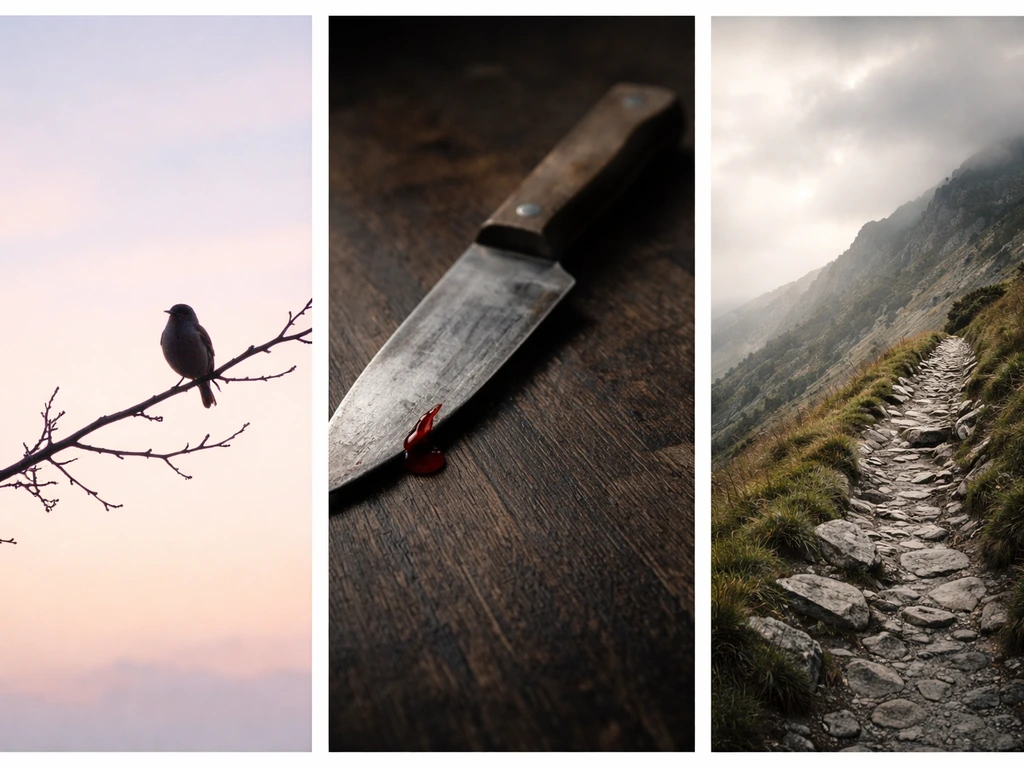
The mythic/folklore reading and the folk lyric reading are the two that fit most naturally when you take all five words together at face value. If you are looking for what “killing a bird meaning” refers to, compare it to the common proverb-style or metaphorical readings for harm and consequences mythic/folklore reading. The image of a bird (soul or spirit) marked by a knife, bleeding, and still moving upward toward a mountain is a coherent arc: wounding, persistence, ascent. It reads like a compressed hero's journey or a ritual cost paid for spiritual progress.
How to confirm the actual meaning today
Since no exact source for this phrase turned up in a direct search, here are the most effective steps to track it down and verify the meaning.
- Search the exact string in quotes: put 'knife blood bird bird up mountain' in quotes on Google, then try removing one word at a time to find partial matches. Also try it without 'blood' and without the doubled 'bird' separately.
- Add the format you think it came from: pair your search with words like 'lyrics,' 'riddle,' 'meme,' 'poem,' or 'quote.' Try 'knife blood bird mountain lyrics' or 'knife blood bird riddle meaning.'
- Search the source platform directly: if you saw it on TikTok, Reddit, or Instagram, go back to that platform and search the phrase there. Platform-native search often finds content that Google misses, especially memes and short-form videos.
- Try a lyrics database: paste fragments into Genius, AZLyrics, or Musixmatch. Even partial line matches can surface the song if it is a lyric.
- Check the surrounding lines: if you remember any other words from the same passage, search those instead. Surrounding text is almost always more unique than the bird-and-mountain imagery, which appears in dozens of unrelated works.
- Test your interpretation against the whole passage: once you have a reading you think fits, go back and check every other word in the source against it. A good interpretation explains all the words, not just the ones you focused on.
- Ask in a fandom or lyrics community: if you think it comes from a specific artist, game, or show, post in that community's Reddit or Discord. Fans are remarkably fast at identifying obscure lyric fragments and game text.
One more thing worth checking: if the phrase felt dark or death-adjacent in tone, it may connect to broader bird symbolism around mortality and omens, territory that overlaps with questions about what birds symbolize in the context of death, killing a bird as a metaphor, or mourning bird imagery. Those threads show up regularly in the same kind of lyric and folklore spaces where a phrase like this would live.
FAQ
How can I tell whether this phrase is meant as lyrics, a riddle, or a meme caption?
Start by checking whether you saw it as a standalone caption versus a line inside lyrics or a riddle. If it appears in a verse, “knife blood bird bird up mountain” is more likely compressed metaphor or narrative imagery, while standalone use is more likely a meme remix or transcription error (for example, “bird bird” could be “bird” repeated by a parser or editor).
Does the exact wording “up mountain” (without an article) change the interpretation?
Look closely for punctuation or capitalization in the original post or lyric. “Up mountain” without “the” strongly suggests a fragment, translated rhythm, or a stylized command, so the grammar often points to how the original author wanted the line to sound rather than a literal location.
What if “bird bird” was a typo, but I cannot find the original source?
If “bird bird” seems doubled, check whether the source also has other repeated words or rhythmic mirroring. In riddles and lyric fragments, repetition usually serves emphasis or meter, so treating it as two distinct birds might be less accurate than treating it as a single bird image intensified by the author.
Could “bird” mean something slang-related instead of a literal animal or symbolism?
Confirm whether the context includes drugs, street slang, or references to weight or contraband, since “bird/birds” can refer to cocaine in some rap contexts. If those signals are present, knife and blood may be describing violence and cost in that world rather than mythic soul imagery.
How do I handle the possibility that the source bird was a specific species?
Species-specific bird associations can flip the mood, so focus on whether the surrounding text mentions grief, death omens, transformation, or particular places and weather. If the source names a bird type (owl, raven, crow, stone-curlew), use that as a tie-breaker, otherwise default to generic “spirit or life” symbolism.
What is the fastest way to check if my interpretation is internally consistent?
Try a quick interpretation test: read it as an “arc” (wounding, consequence, upward persistence). The metaphorical reading that matches best is the one where the bird image can be seen as something alive and free that becomes threatened, then still moves toward a destination or breakthrough.
What are practical ways to track the original phrase if direct search fails?
The article’s strongest practical step is source identification, so you can replicate that process locally: search exact quotes including the double word (“bird bird”) and try alternative spacing or punctuation variants. Then compare the earliest matches to later reposts, since meaning can drift when memes are copied without the original context.
How can I distinguish a hero-journey meaning from a warning/proverb meaning?
If you are mapping it to the proverb or folk “harm and consequences” style, watch for whether the phrase implies an irreversible cost (blood) and a goal (mountain). If it reads like progress through hardship, it leans toward “ritual cost for ascent,” while if it reads like warning or punishment, it leans toward moral consequence.
Is it safe to assume the knife and blood are literal, or should I treat them as symbols?
If you want to interpret it literally, check whether “knife” and “blood” appear as concrete objects and bodily injury in the surrounding lines. Most of the time, literal injury plus “bird” still functions as metaphor in poetry and folklore, so use literal reading only when the surrounding text is clearly physical and non-symbolic.
Next Article
Killing a Bird Meaning: Literal vs Idiomatic Use
Learn the meaning of killing a bird: literal harm vs idiomatic phrase, how to spot it in context, and safe paraphrases.