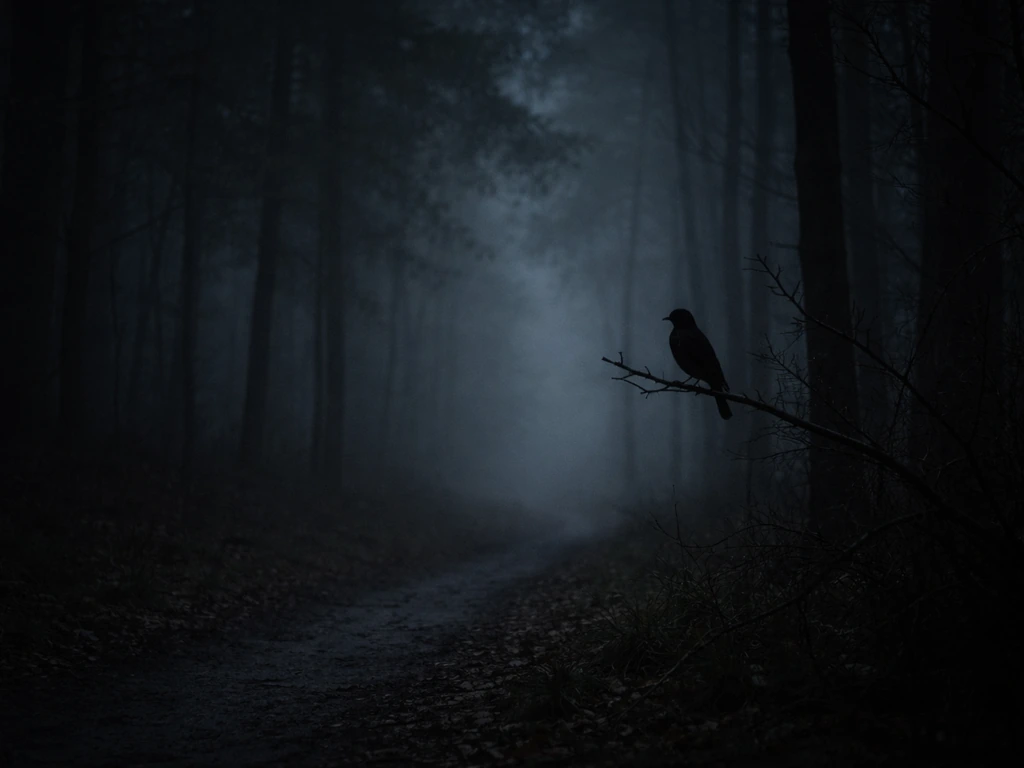
If you searched 'murder bird meaning,' you're almost certainly looking for one of two things: the idiom 'a murder of crows' (which is the collective noun for a group of crows), or a specific pop-culture or literary reference where 'murder bird' appears as a phrase or nickname. The vast majority of the time, it's the first one. A murder of crows simply means a flock of crows, and the word 'murder' has nothing to do with the crime. It's an old, poetic piece of English vocabulary that has made a big comeback in modern usage.
Murder Bird Meaning: Origins, Crows vs Ravens, and Context

Marcus Reeves
24 Apr 2026
"Murder bird" as slang vs. what it literally means
There's no single official phrase called 'murder bird' in standard English. What you're most likely encountering is a casual shorthand or slight misquote of 'murder of crows,' where someone refers to a crow or raven as 'the murder bird' because of the word's association with that collective noun. That's a natural compression of language, and plenty of writers, social media users, and horror fans use it that way.
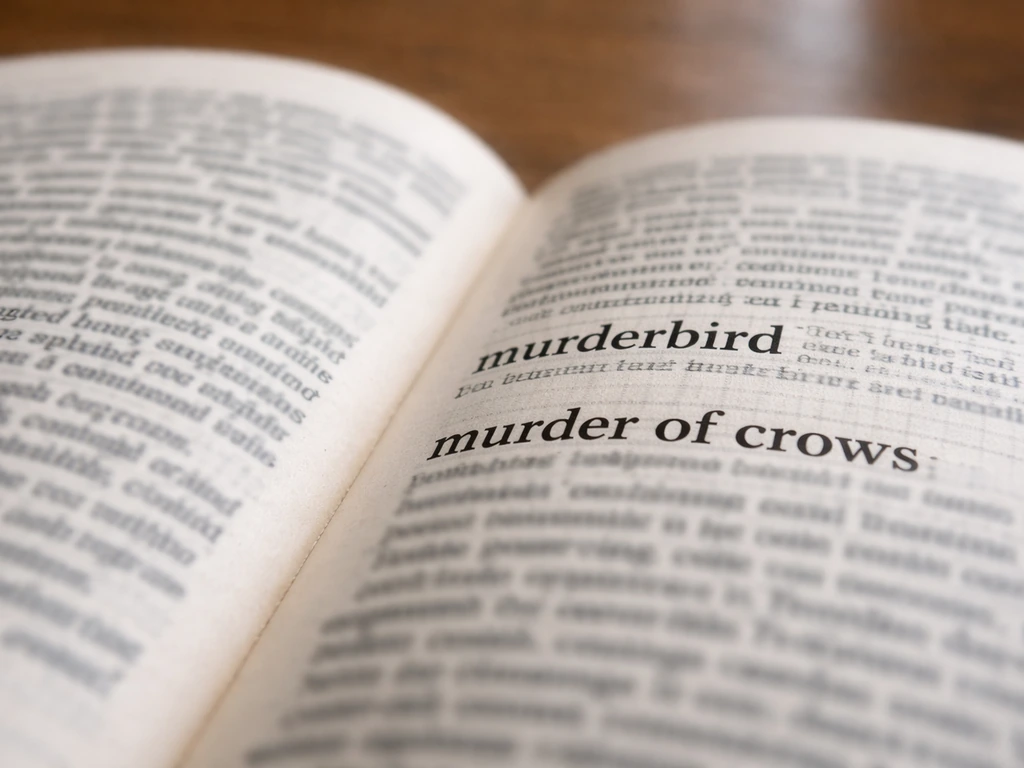
That said, 'murderbird' (one word) does have its own separate dictionary entry. Wiktionary records it as a rare noun for the butcherbird or shrike, a small predatory bird known for impaling prey on thorns. Merriam-Webster defines “butcher-bird” as various shrikes, which is closely related to the “murderbird/murder bird” ambiguity in bird contexts butcherbird or shrike. So if you see 'murderbird' in a nature article or bird-watching context, it may actually refer to the shrike rather than to crows at all. Context is everything here.
Outside of those two uses, 'murder bird' sometimes floats around in fandom, music, or fiction as a nickname or metaphor for any bird associated with death, violence, or the macabre. Think of a character in a dark fantasy novel whose familiar is a raven, or a band that calls its mascot a 'murder bird.' These are creative extensions, not dictionary definitions, so you need to read the surrounding context to pin down the meaning.
Why crows and ravens get tied to the word "murder"
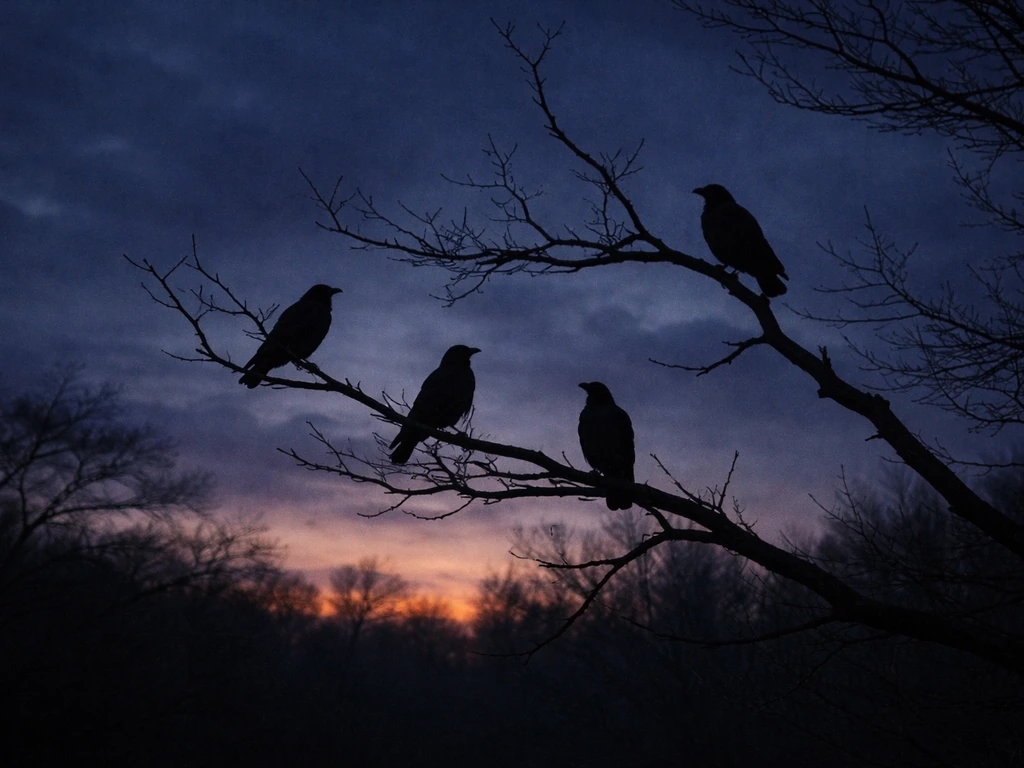
Crows and ravens have carried a reputation for darkness for centuries, and it's not arbitrary. Both birds are highly intelligent, opportunistic scavengers that historically appeared on battlefields to feed on the dead. Medieval Europeans noticed this and layered on superstitions: a crow landing on your roof was an omen of death; a raven flying overhead was a bad sign. That cultural weight gave the birds a sinister aura that language eventually absorbed.
The earliest written record of 'a murder of crows' appears in a medieval manuscript from around 1475, where it's spelled 'a mursher of crowys.' The manuscript doesn't explain why that word was chosen, and etymologists have offered a few theories over the years. Cambridge ties it to the birds scavenging on battlefields. The Oxford English Dictionary suggests an allusion to the crow's 'traditional association with violent death' or possibly to its harsh, raucous cry. Merriam-Webster is honest about the ambiguity: the origin is plausible but not proven.
Ravens carry similar symbolism but are typically discussed separately. A group of ravens is called an 'unkindness' or a 'conspiracy,' which are equally dramatic collective nouns from the same medieval tradition. In practical usage, though, people often use 'murder of crows' loosely to cover ravens too, especially in creative writing, because the two species share so much symbolic overlap: intelligence, black plumage, association with death, and a long history in folklore.
What "a murder of crows" actually means and how people use it
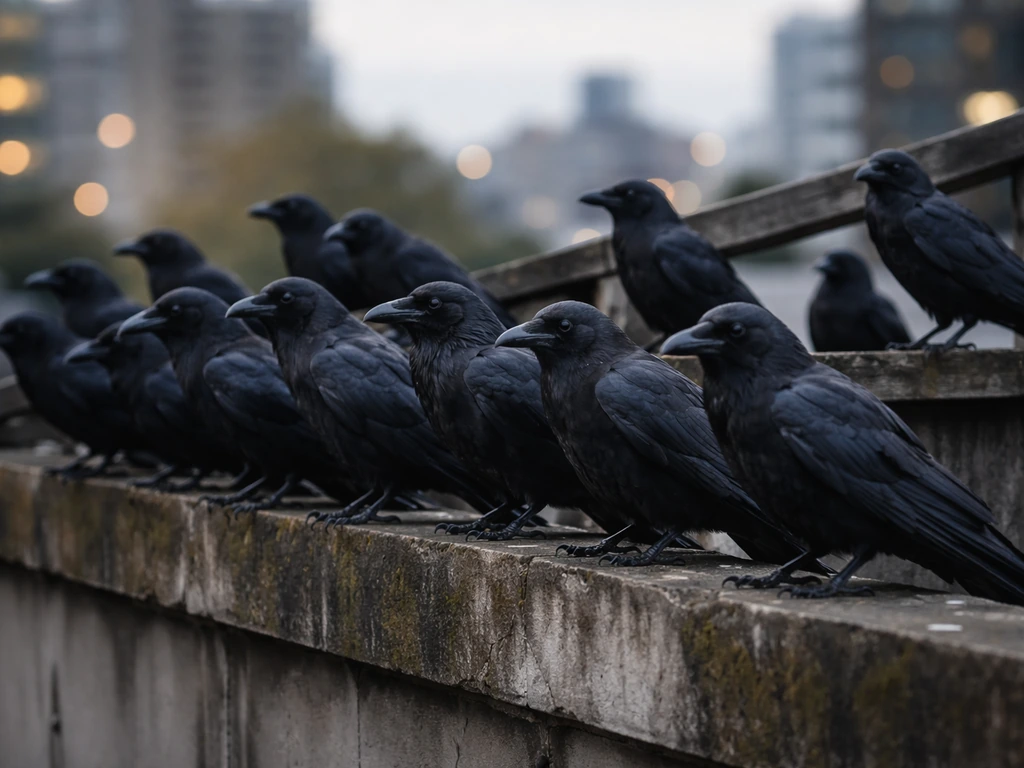
At its core, 'a murder of crows' is a collective noun, meaning it's just the term for a group of those birds. It works the same way as 'a flock of seagulls,' 'a pack of wolves,' or 'a school of fish.' The word 'murder' here carries no legal or violent meaning on its own. It's a descriptor for the group.
In everyday use, though, people reach for 'a murder of crows' specifically when they want to evoke atmosphere. If a writer says 'a flock of crows landed on the fence,' that's neutral. If they say 'a murder of crows settled on the fence,' it suddenly feels ominous. That tonal difference is why the phrase has survived and thrived while other old collective nouns (a shrewdness of apes, a parliament of owls) stay buried in trivia books. 'Murder of crows' earns its keep by doing double duty: naming the group and setting a mood.
It's worth noting that this phrase is more literary and folk tradition than serious ornithology. Audubon has pointed out that birders and field guides don't actually use 'murder of crows' in scientific contexts. It's a term of venery, part of an old poetic tradition of giving dramatic names to animal groups, and it was largely rediscovered and popularized in the 20th century rather than being in continuous use since medieval times.
Where you'll spot "murder bird" in literature, music, and pop culture
The phrase gets used across a wide range of creative contexts, and knowing those touchstones helps you decode it fast when you encounter it.
- Gothic and horror fiction: Writers frequently use 'murder bird' or 'murder of crows' as shorthand for impending doom. A crow or raven appearing before a death scene is a well-worn literary device, and calling it a 'murder bird' layers in that collective-noun baggage deliberately.
- Music: Several bands and song titles invoke 'murder of crows' or 'murder bird' imagery in metal, folk, and alternative genres. The phrase signals a dark, atmospheric aesthetic rather than a specific narrative.
- Social media and memes: Crows are wildly popular on wildlife social media, and 'murder bird' is used affectionately or humorously to describe them. A photo of a crow staring menacingly at the camera captioned 'the murder bird has arrived' is joking with the symbolism, not using it literally.
- Tattoo and art culture: 'Murder bird' appears frequently in dark or gothic visual art as a label or title for crow and raven imagery, drawing on the collective-noun tradition.
- Video games and fantasy fiction: Characters associated with crows, ravens, or death magic often get 'murder bird' as a nickname, either in the text itself or in fan communities discussing the work.
Edgar Allan Poe's 'The Raven' is probably the single biggest cultural anchor for all of this. The raven in that poem is never called a murder bird, but it cemented the raven-as-death-omen image so thoroughly in Western culture that any subsequent dark bird reference owes it something. If you're trying to understand a 'murder bird' reference in literature, asking whether the piece is in conversation with that gothic tradition is a useful starting point.
Related bird idioms and where people get confused
A few points of confusion come up regularly around this phrase, and it's worth clearing them up.
| Term | What it means | When to use it |
|---|---|---|
| A murder of crows | Collective noun for a group of crows | When naming or describing a group of crows, especially for atmosphere |
| A flock of crows | Generic collective noun, also correct | When you want a neutral, scientific, or everyday tone |
| An unkindness of ravens | Collective noun for a group of ravens | When the birds are specifically ravens, not crows |
| A conspiracy of ravens | Alternative collective noun for ravens | Same as above; more dramatic in tone |
| Murderbird / murder bird | Informal name for a crow or raven; also separately means shrike | In casual, creative, or humorous writing; check context for shrike meaning |
| Flip the bird | Completely unrelated slang: to give the middle finger | Has nothing to do with crows, murder, or collective nouns |
It's also worth knowing that 'bird' on its own carries slang meanings in some regions. In British English, 'bird' can mean a girl or woman. In some American slang, 'bird' is used to refer to a person generally. Neither of those has anything to do with the 'murder bird' phrasing unless the context strongly suggests otherwise. If the conversation is at all about animals, nature, writing, or dark aesthetics, you're almost certainly back to crows.
If you're exploring related territory, the symbolism around what bird means death and the idea of killing a bird meaning something ominous in literature both connect to the same cultural thread. Mourning bird imagery and the broader question of dark bird omens across cultures all draw from the same well as the murder-of-crows tradition. If you are wondering about mourning bird meaning, it can help to compare how cultures treat grief-symbol birds alongside murder-of-crows symbolism Mourning bird imagery.
How to figure out what it means in whatever you're reading
When you hit 'murder bird' and aren't sure which meaning applies, run through these quick context checks. If you're also seeing similar phrases like knife, blood, or ominous “bird” references, the same context checks will help you pin down which meaning is intended knife blood bird bird up mountain meaning. If you meant killing a bird meaning, check whether the text is using a moral or ominous twist rather than the literal collective noun for crows. The phrase "shoot the bird meaning" is often related to the same kind of dark, idiom-like usage, so checking the surrounding context can clarify which sense applies.
- Is there an actual bird in the scene? If crows, ravens, or dark birds are physically present or described, you're almost certainly looking at a riff on 'murder of crows.'
- Is the tone gothic, dark, or atmospheric? That's a strong signal the phrase is being used for its ominous connotations rather than as a literal descriptor.
- Is it humorous or affectionate? Social media and meme culture use 'murder bird' as a loving nickname for crows. A funny photo plus that caption equals playful use of the idiom.
- Is it in a nature or birding context? If so, consider whether the author might mean shrike (the butcherbird), especially if other small predatory bird species are being discussed.
- Is there a proper noun involved? A character named Murder Bird, a band, or an album title suggests a creative reference rather than an idiom. Search the specific name alongside the work's title.
- Does the surrounding text reference death omens or folklore? That points you squarely to the crow-symbolism tradition rather than any other meaning.
Quick examples and how to translate them

Here are some real-world-style examples of how 'murder bird' gets used, and what each one actually means in plain English.
| Example | What it means | Plain English translation |
|---|---|---|
| 'A murder of crows watched from the oak tree as she left the house for the last time.' | Collective noun used for dark atmosphere | A group of crows watched from the oak tree (with an ominous tone) |
| 'The murder bird has found my car again' (photo of a crow on a windshield) | Affectionate/humorous slang for a crow | A crow is sitting on my car again |
| 'The shaman's murder bird circled overhead before the battle began.' | Poetic/literary use of 'murder bird' as a death omen | A crow or raven appeared as a bad omen before the battle |
| 'Chapter 3: The Murder Birds' (chapter heading in a gothic novel) | Title using crow symbolism for atmosphere | This chapter involves crows or dark bird imagery and is setting an ominous tone |
| 'Look at this murder bird impaling a grasshopper' (nature post) | Literal use of 'murder bird' meaning shrike/butcherbird | This is a shrike, a small predatory bird known for skewering prey |
If you're a writer trying to use this phrase yourself, the safest and clearest move is to write 'a murder of crows' in full when you want the collective-noun meaning, and to use 'murder bird' only when the context makes the informal, shorthand nature obvious. Leaning into the ambiguity can be a stylistic choice, but your reader needs enough surrounding context to land on the right interpretation. A well-placed crow in a dark scene does most of the work for you before you ever reach for the word 'murder.'
FAQ
When someone says “murder bird” in a story, do they mean a real murder or just the ominous crow flock idea?
If the phrase appears in a writing prompt, song lyric, or horror fandom post, it usually signals the mood of “a murder of crows” (a group of crows) rather than any literal act of killing. Look for nearby clues like “landed,” “settled,” “on the fence,” or a countable group of birds.
Is “murder bird” an official English idiom on its own?
In standard English, “murder bird” by itself is not a fixed dictionary idiom the way “a murder of crows” is. So if you see “murder bird” without any additional context, your best assumption is shorthand or a creative nickname, then verify by scanning for whether the bird is explicitly a crow or raven.
Can “murder bird” be referring to ravens, even though the phrase is usually about crows?
Often, yes. People frequently use “murder of crows” loosely for ravens in fiction because the symbolic baggage overlaps. If the text specifies “raven,” “nevermore,” or a raven-like character, treat it as raven imagery even if the phrasing uses “murder of crows” patterns.
What changes if the phrase is written as “murderbird” (one word) instead of “murder bird”?
If the word appears as “murderbird” (one word) in a nature or bird-watching context, it may be referencing the butcherbird or shrike, a predatory bird known for impaling prey. In that case, the meaning is about species identification, not a flock omen.
How can I tell whether a reference is leaning more toward raven symbolism than crow symbolism?
Crows and ravens can both show up in “death omen” symbolism, but ravens are more strongly tied to classic gothic literature (especially Poe) and “unkindness” as a traditional group name. If your reference mentions gothic themes, Edgar Allan Poe, or “unkindness,” that nudges interpretation toward ravens.
Could “bird” in “murder bird” mean a person instead of an actual animal?
If you see “bird” used to mean a person (common in some slang) and the surrounding text is about relationships or gossip, then “murder bird” could be figurative toward a human, not an animal. The clue is whether the text is about social interactions rather than weather, fields, fences, or flight.
What quick context tests can I use to avoid misreading “murder bird”?
The safest check is grammatical and semantic: collective-noun usage will often pair with verbs for groups (“gathered,” “settled,” “swarmed”) and plural birds. Slang or personal nickname usage tends to pair with human verbs (“meet,” “betray,” “date”) and roles rather than animal behavior.
If I’m writing and want the “murder bird” vibe, how do I keep it clear for readers?
Writers commonly compress the phrase for style, but you can reduce ambiguity by using “a murder of crows” the first time, then “murder bird” later only if the scene already established the bird species. Readers need that anchor to know whether you mean collective noun or a nickname.
What if “murder bird” shows up next to words like knife or blood, does that change the meaning?
Yes. If a “murder” word cluster appears (knife, blood, killing, ominous “bird” metaphors), the intended meaning may be “macabre metaphor” rather than the collective noun. Still, the most common fallback is that the author means the crow flock mood and uses other dark language to intensify it.
Is “murder of crows” a scientific bird term or just a poetic one?
Audiences often expect ornithology when they see bird group terms, but “murder of crows” is a poetic venery term, not a technical field-guide label. If the text claims scientific classification or birdery details, treat it as stylistic rather than literal ornithology.
Next Article
What Bird Means Death: Symbolic Meanings and Real Causes
Learn what common birds symbolize death, plus real causes and safe steps to ID the species and avoid overreacting.