
A 'ravenous bird' can be either completely literal (a bird that is extremely hungry or aggressively feeding) or figurative (a symbol for ferocity, predatory power, greed, urgency, or relentless ambition). Understanding the phrase closely also helps clarify the deeper meaning behind related imagery like thirst, reckoning, and directional cues thirst reckoned bird north meaning. Which meaning applies depends almost entirely on the sentence around it. In everyday writing and captions, the phrase usually leans figurative. In nature writing or wildlife contexts, it tends to be straightforwardly literal. And in one very specific and famous context, the Bible's Isaiah 46:11, it functions as a metaphor for a powerful conquering agent summoned from afar.
Ravenous Bird Meaning: Literal and Idiomatic Uses


Literal vs. figurative: what 'ravenous bird' actually means
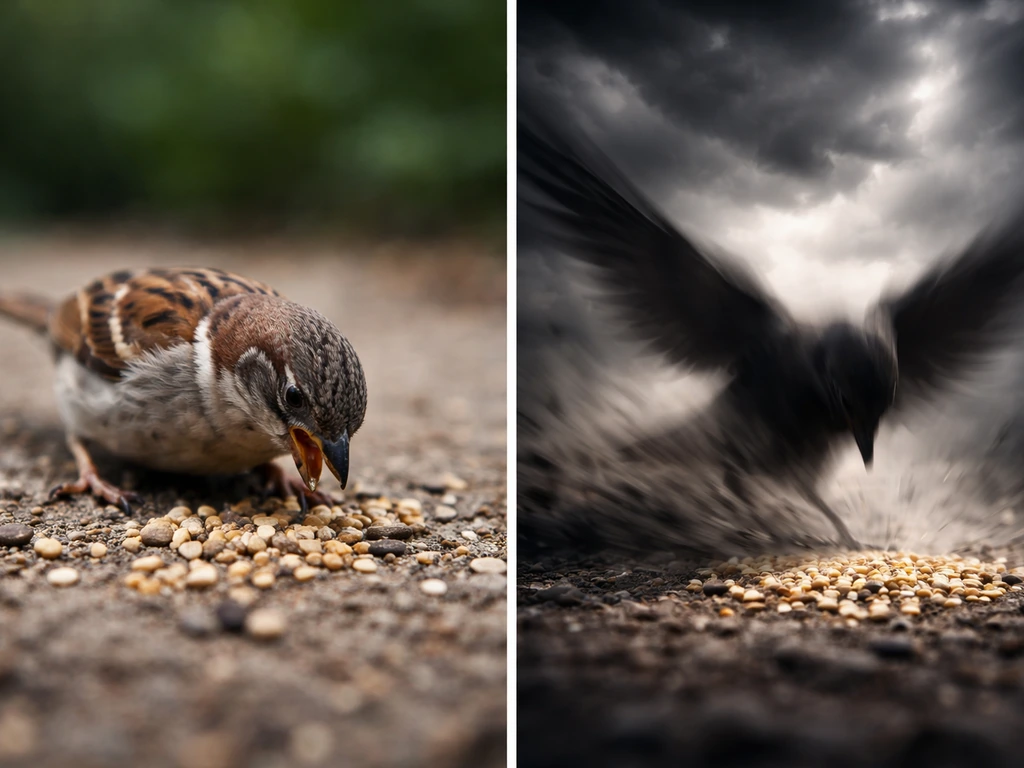
At the root level, 'ravenous' simply means extremely hungry or voraciously eager. The Cambridge Dictionary defines it as 'extremely hungry,' and Merriam-Webster adds the shade of being 'very eager or greedy for food, satisfaction, or gratification.' The word comes from older roots tied to 'voracious' and 'preying,' which is why it carries that aggressive edge rather than just meaning peckish.
So in a literal sense, a ravenous bird is an actual bird in a state of intense hunger, often feeding aggressively or hunting with urgency. Think of a hawk mantling over its kill, or seabirds mobbing a fishing boat. That image is exactly what the word was built for.
Figuratively, a ravenous bird stretches outward from that image to describe anything or anyone that is relentlessly hungry for power, opportunity, resources, or dominance. The bird part of the phrase brings in speed, predation, and a sweeping quality that 'ravenous' alone doesn't quite capture. Together, they make a phrase that signals fierce, targeted hunger with movement behind it.
Where you're most likely to see this phrase
Biblical and literary contexts
The most famous use of 'ravenous bird' in English comes straight from the King James Bible. Isaiah 46:11 reads: 'Calling a ravenous bird from the east, the man that executeth my counsel from a far country.' Biblical scholars and commentators widely interpret the 'ravenous bird' here as a bird of prey, most likely an eagle, functioning as a metaphor for Cyrus the Great of Persia. The phrase isn't about hunger in any dietary sense. It's about predatory swiftness, unstoppable force, and the execution of a purpose. If you're encountering the phrase in a theological, literary, or historical context and someone references 'a ravenous bird from the east,' that's the lineage they're drawing from. The related phrase 'ravenous bird from the east' carries its own layer of meaning worth exploring separately. On Urban Dictionary, readers sometimes ask "thirst reckoned bird meaning" as a comparison point for how oddly phrased bird metaphors get interpreted online, even though it can be unrelated to the established "ravenous bird" usage thirst reckoned bird meaning Urban Dictionary. If you want the exact meaning, especially in Isaiah, look at how the phrase functions as a metaphor for a summoned force ravenous bird from the east.
Outside the Bible, literature and poetry use 'ravenous bird' to invoke similar imagery: a predator closing in, ambition that cannot be satisfied, or fate arriving with talons out. The phrase shows up in creative writing as a way to make hunger feel dramatic and inevitable rather than merely biological.
Social media captions and everyday writing
On social media, you'll occasionally see 'ravenous bird' in captions for bird photography, usually describing a raptor mid-hunt or a seagull going aggressively after food. Here it's mostly literal with a theatrical flair. Someone posting a photo of an osprey diving might write 'ravenous bird doing what it does best' to add drama. You'll also see the phrase used more loosely for personal hunger captions, though that's a rarer stretch.
Poetry and creative writing prompts
In poetry and creative writing, 'ravenous bird' is often a deliberate symbol choice. Writers reach for it when they want hunger to feel predatory rather than passive, or when they want to describe ambition, grief, obsession, or longing as something that circles and swoops rather than just sits with a person. If you've encountered it in a poem or a writing prompt, the figurative meaning is almost certainly in play.
What a 'ravenous bird' symbolizes

The phrase carries several layers of symbolism depending on the context, but they all share a common thread: intensity directed outward.
- Hunger and drive: The most direct reading. Whatever the ravenous bird is pursuing, it will not stop until it gets it. This maps easily onto ambition, obsession, addiction, or competitive drive.
- Predatory aggression: A ravenous bird isn't just hungry, it's hunting. This adds a dimension of threat or dominance, suggesting the subject is not passive but actively taking from the world around them.
- Speed and decisiveness: Birds of prey move fast and commit fully. The 'ravenous bird' symbol often implies someone who acts without hesitation when they spot an opportunity.
- Power and inevitability: The Biblical use reinforces this reading. When a ravenous bird is 'called' to do something, it arrives with force. The phrase can symbolize fate or a powerful agent set in motion.
- Greed or destructive appetite: On the darker end, the phrase can symbolize unchecked consumption, someone or something that takes more than it needs and leaves damage behind.
Related bird expressions worth comparing
Bird language is full of hunger and predation imagery, and it helps to know how 'ravenous bird' sits alongside similar phrases so you don't conflate them.
| Phrase | Core meaning | Tone |
|---|---|---|
| Ravenous bird | Extremely hungry or predatory; intense driven force | Dramatic, literary, serious |
| Bird of prey | A predator bird; a person who exploits others | Neutral to threatening |
| Vulture (used figuratively) | Someone who circles and waits for others to fail | Negative, opportunistic |
| Eagle (used figuratively) | Power, vision, national or divine strength | Positive to awe-inspiring |
| Ravenous bird from the east | Biblical metaphor for a conquering agent summoned by God | Prophetic, weighty |
| Early bird | Someone who acts quickly and gains an advantage | Positive, energetic |
| Hungry as a hawk | Very hungry, watchful and ready to strike | Casual, colloquial |
The key distinction between 'ravenous bird' and a phrase like 'vulture' is direction and energy. A vulture metaphor implies patient, passive waiting for collapse. A ravenous bird is active, moving, already in pursuit. If you're comparing this to the figurative use of ravens specifically, that's a different track entirely, since ravens in symbolism are more tied to mystery, death, and intelligence than raw hunger.
How to figure out which meaning applies in a specific sentence

If you've stumbled on the phrase in a quote, poem, or post and you're not sure whether it's literal or figurative, run through this checklist quickly.
- Is it describing an actual bird in a real-world or wildlife context? If yes, it's likely literal. Nature writing, wildlife photography, and animal behavior descriptions almost always use it literally.
- Is it from a religious, theological, or historical text? Check for Isaiah 46: 11 or similar prophetic language. If so, 'ravenous bird' is a metaphor for a powerful agent or force, not a hungry animal.
- Is the subject of the sentence a person, group, company, or abstract force like ambition or fate? Then it's figurative. The 'bird' is a lens, not the actual subject.
- Does the surrounding language feel dramatic or elevated? Words like 'summoned,' 'descends,' 'circles,' 'swoops,' or 'preys upon' alongside 'ravenous bird' all point to figurative, symbolic use.
- Is there any reference to 'the east' or direction? That's almost certainly a Biblical echo and should be read in that prophetic context.
- Is the tone casual or humorous? If someone is using it lightly, they probably just mean someone or something is intensely hungry or eager, the most accessible figurative reading.
How to use 'ravenous bird' yourself
If you want to use the phrase in your own writing, a few things are worth keeping in mind. It reads as elevated and slightly archaic, which makes it a great fit for poetry, literary fiction, or any writing that wants a dramatic, predatory image. It does not fit naturally in casual conversation or informal prose because it sounds like it belongs in a chapter heading or a psalm, not a text message.
Use it when you want to describe something that is both hungry and in motion: a competitor closing in, ambition that has turned predatory, a grief that keeps returning, or a force that feels inevitable. Avoid it if you simply mean someone is hungry or eager, because the phrase carries too much dramatic weight for lightweight use and can come across as overwrought.
Example sentences
- Literary: 'She moved through the industry like a ravenous bird, leaving nothing untouched.'
- Poetic: 'Ambition, that ravenous bird, had long since stripped the tree bare.'
- Nature writing (literal): 'The ravenous bird had been circling the field for an hour before it finally dove.'
- Biblical echo: 'He came from the east like a ravenous bird, swift and relentless in purpose.'
If the tone feels too heavy, try these alternatives
- Bird of prey (slightly less dramatic, more commonly understood)
- Predatory (direct, no metaphor required)
- Voracious (keeps the hunger intensity without the bird imagery)
- Relentless (loses the hunger angle but captures the unstoppable movement)
- Hungry as a hawk (more casual, colloquial feel)
If you're writing something that touches on the specific Biblical framing, particularly anything involving the phrase 'ravenous bird from the east,' that deserves its own careful treatment since it carries prophetic and historical weight that extends well beyond general hunger symbolism. Many readers connect this idea to the broader concept of Eurasian bird meaning in symbolism and interpretation ravenous bird from the east.
FAQ
How can I tell if “ravenous bird” is literal or figurative in a sentence?
If your text mentions a location plus an arriving force, the phrase is likely figurative, even if it includes a bird. In Isaiah 46:11 it is specifically a metaphor for a summoned conquering agent, so “ravenous” does not describe the agent’s diet. A good clue is whether the surrounding words suggest action over time (calling, summoning, executing counsel).
What’s the safest way to use “ravenous bird meaning” in a social media caption?
In most modern captions and wildlife posts, “ravenous bird” is used figuratively-to-sensationally even when describing a real hunt. If you want a strictly literal tone, name the behavior precisely (diving, mantling, mobbing) instead of relying on the phrase, because “ravenous bird” can sound poetic rather than clinical.
Can “ravenous bird” just mean someone is hungry or eager?
Avoid using it as a synonym for “hungry” or “eager.” The phrase carries aggressive, predatory energy, so readers may interpret it as threat, obsession, or dominance. If you mean mild enthusiasm, “eager,” “voracious,” or “hungry for” will usually land more naturally than the full expression.
Is “ravenous bird from the east” always biblical?
Yes, but it can feel uneven. The expression “ravenous bird from the east” is strongly associated with Isaiah, so using it in a non-biblical context can read as an intentional allusion. If you are not invoking that meaning, choose a different directional phrase (toward the shoreline, from the sky) or describe the action without “from the east.”
How should I handle “ravenous bird from the east” if I’m writing or analyzing a religious text?
When written in a religious or historical passage, keep it specific and respectful. Treat it as metaphor, not a description of a literal animal being summoned. If you are writing commentary, you can frame it as “a bird of prey” or “a predatory symbol” depending on the interpretive angle you are taking, but do not reduce it to hunger.
What’s the difference between “ravenous bird” and “vulture” symbolism?
If the sentence implies patience or waiting for something to happen, you may be describing the wrong symbolism. “Vulture” often suggests passive waiting for collapse, while “ravenous bird” implies pursuit and momentum. Check for verbs like “closing in,” “swooping,” “striking,” versus “waiting,” “lurking,” or “feeding later.”
What kind of wording pairs best with “ravenous bird”?
The phrase usually wants a subject and a sense of motion. Works best with strong verbs (circling, diving, closing in, tracking) and with a target (prey, opportunity, power). If your sentence lacks a directional or action cue, readers may sense exaggeration or interpret it as vague melodrama.
Why does “ravenous bird” sometimes feel melodramatic, and how can I tone it down?
Overuse can make it sound overwrought, especially in casual writing. A practical guideline is to use it once per scene or idea, then switch to simpler language for the follow-up (for example, “the predator” or “the rush of ambition”). Also consider whether the reader needs the bird imagery at all, or just the intensity.
If I mean a real bird, what details should I include to keep it literal?
Yes. If you mean “a bird that looks hungry,” you can add visual or behavioral markers to make it clear (thin-looking, pecking, scavenging). Without those markers, “ravenous bird” can be read as metaphorical, because the phrase is elevated and dramatic even in literal settings.
Citations
Cambridge Dictionary defines **ravenous** as “**extremely hungry**.”
https://dictionary.cambridge.org/us/dictionary/english/ravenous
Cambridge Dictionary also gives a figurative sense: **“wanting something very much or wanting a lot of something”** (e.g., ravenous appetite/craving).
https://dictionary.cambridge.org/us/dictionary/english/ravenous
Merriam-Webster defines **ravenous** as (sense summarized on page) **very eager or greedy for food/satisfaction/gratification** and provides contemporary example sentences using this “intense craving” framing.
https://www.merriam-webster.com/dictionary/ravenous
Online Etymology Dictionary notes **ravenous** means “**voracious, furiously hungry**,” and also relates the word historically to meanings like “voracious”/“preying,” reinforcing its strong literal-hunger/aggression associations.
https://www.etymonline.com/word/ravenous
Isaiah 46:11 includes the exact phrase **“calling a ravenous bird from the east”** and the surrounding clause frames it as a **summons of a person/agent** who will execute counsel/purpose (“the man…that executeth my counsel…” in KJV wording).
https://www.biblegateway.com/verse/en/Isaiah%2046%3A11
Bible Study Tools (KJV) prints the surrounding sentence: **“Calling a ravenous bird from the east, the man that executeth my counsel from a far country…”**, showing that “ravenous bird” functions as a **metaphor for a powerful leader/agent (commonly identified as Cyrus)** rather than literal hunger.
https://www.biblestudytools.com/kjv/isaiah/46-11.html
BibleHub commentary (Isaiah 46:11) explicitly notes a typical interpretive rendering: **“Calling a ravenous bird; rather, a bird of prey.”** This indicates the phrase signifies **predatory/ferocious swiftness** imagery in context.
https://biblehub.com/commentaries/isaiah/46-11.htm
A scholarly article (“Cyrus, Yhwh’s Bird of Prey (Isa. 46.11)…”) discusses interpretive options and notes debate over whether “ravenous bird” should be read as **an eagle/ensign symbol linked to Cyrus** or as a metaphor for ferocity/swiftness and spoils.
https://www.sagepub.com/doi/10.1177/0309089210365963
Thirst Reckoned Bird Meaning on Urban Dictionary
Understand slang meaning of thirst reckoned bird, how people use bird in memes, plus examples and how to confirm intent.