
If you ran into 'ravenous bird from the east' in a biblical or literary context, the phrase almost certainly refers to the passage in Isaiah 46:11 in the King James Bible, where God declares he is 'calling a ravenous bird from the east, the man that executeth my counsel from a far country. If you need the quick takeaway on ravenous bird meaning, this Isaiah-based explanation is the best place to start before getting into slang usage.
Ravenous Bird From the East Meaning Explained

Marcus Reeves
19 May 2026

' The 'ravenous bird' is a metaphor for Cyrus the Great of Persia, and 'the east' points to his origins in what is now Iran. Outside that specific biblical framing, the phrase works as a wider idiom for a powerful, aggressive force arriving from the east, whether that's a person, a nation, or an idea. Knowing which context you saw it in is the fastest way to nail down exactly what it means.
Where 'ravenous bird from the east' comes from
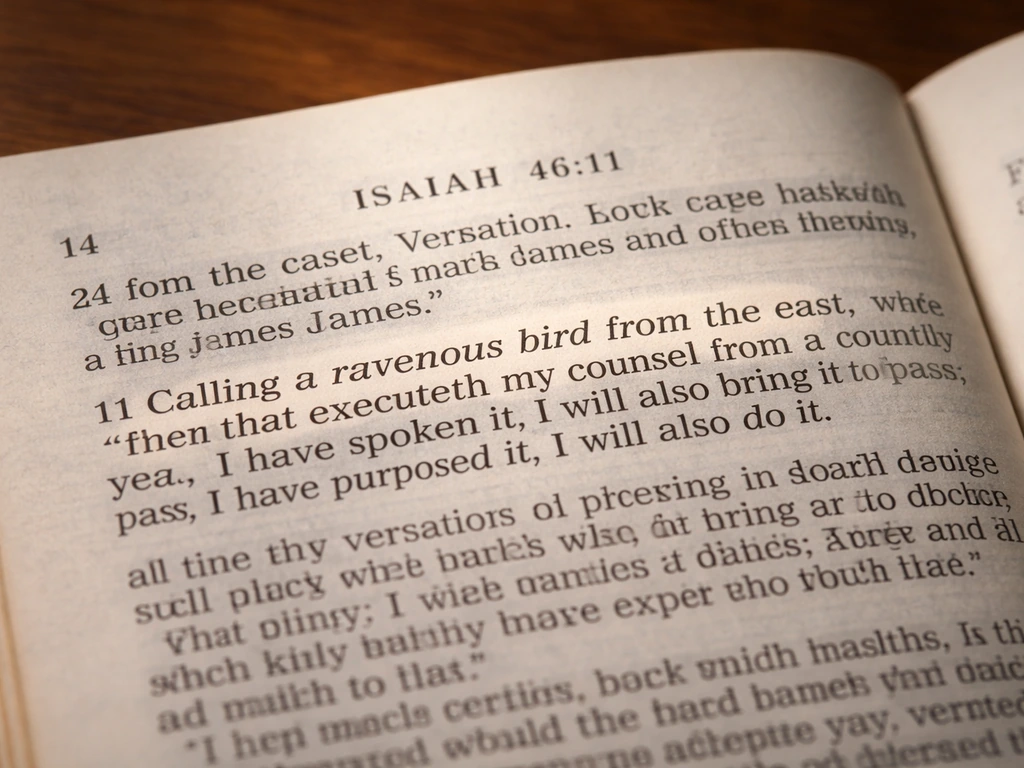
The phrase has a clear and traceable origin: Isaiah 46:11 in the King James Version of the Bible, written in Early Modern English and first published in 1611. The full verse reads, 'Calling a ravenous bird from the east, the man that executeth my counsel from a far country: yea, I have spoken it, I will also bring it to pass; I have purposed it, I will also do it. ' The second half of that verse is the key.
The parallel structure, where 'ravenous bird from the east' is immediately followed by 'the man that executeth my counsel from a far country,' is the Bible's own clarification that the bird is a stand-in for a man. Most scholars identify that man as Cyrus II of Persia, the king who conquered Babylon in 539 BCE and later allowed the Jewish exiles to return home.
The 'ravenous bird' image draws on the predator bird as a symbol of swift, decisive military power. The eagle and the hawk were the most commonly associated birds with that imagery in the ancient Near East, though the text itself doesn't name a specific species.
Outside the Bible, the phrase doesn't appear to have an independent idiomatic life in English before the 20th century. When you see it in modern writing, it's almost always either a direct biblical quotation, an allusion to that passage, or a creative riff on the same imagery for dramatic effect. That's worth knowing because it narrows down your interpretive work considerably.
How the phrase gets used in slang and idioms (and where people go wrong)
The most common misreading is treating 'ravenous bird' as a literal description of a real bird species rather than a metaphor for a person or force. A second misreading, especially online, is conflating 'ravenous bird' with the raven specifically, since 'ravenous' sounds like it contains the word 'raven.' It doesn't, etymologically. 'Ravenous' comes from Old French 'ravine,' meaning violent rush or plunder, and it simply means extremely hungry or predatory. Ravens are fascinating birds with their own rich symbolism, but the word 'ravenous' doesn't make the Isaiah passage about ravens. If you're exploring ravenous bird meaning more broadly, the phrase is really about the quality of the bird (predatory, hungry, swift) rather than a named species.
In slang and casual use, someone might call a person a 'ravenous bird from the east' as a dramatic, slightly archaic-sounding way to describe an aggressive newcomer, a competitor sweeping in from abroad, or a disruptive force arriving unexpectedly. It carries a vaguely threatening, slightly biblical flavor that people use for rhetorical punch. You'll also find it used in certain prophecy-oriented religious communities, where the phrase is debated as a reference not only to Cyrus but to future figures. That's a specific interpretive tradition, not a mainstream English idiom, but it does show up in enough online forums that it's worth knowing it exists.
How to figure out which 'bird' and which 'east' a writer actually means

Context does almost all of the work here. Run through these questions when you encounter the phrase:
- Is the source text religious, prophetic, or theological? If yes, the phrase is almost certainly referencing Isaiah 46:11, and the 'bird' is Cyrus or a figure being compared to Cyrus.
- Does the surrounding text mention Persia, Babylon, exile, or ancient Near Eastern history? That locks in the biblical interpretation.
- Is the text literary fiction, poetry, or drama? The writer is probably using the Isaiah allusion for its dramatic weight rather than making a direct biblical argument.
- Is 'the east' treated as a geographic direction, a specific country, or a cultural concept (like 'the mysterious east')? Each signals a different tradition.
- Does the text treat the bird as a positive force, a negative one, or ambivalent? In Isaiah, the ravenous bird is God's instrument, so it's powerful and purposeful, not simply villainous.
- What time period was the text written in? Pre-20th century English texts referencing a 'ravenous bird from the east' are almost certainly engaging directly with the KJV. Modern texts may be using it more loosely.
If you're still unsure after checking those, search the phrase alongside whatever keyword defines the surrounding topic (the author's name, the book title, the religious tradition) and you'll usually surface a direct explanation within a few results.
Where similar wording shows up in literature and culture
Beyond the Isaiah text itself, the imagery of a predator bird from the east (or from afar) sweeping in as a conquering force appears across a wide range of traditions. In ancient Mesopotamian and Persian literature, eagles and vultures regularly symbolized military conquest. In Greek epic poetry, birds of prey descending from specific directions were omens tied to named gods or specific cities. In English literature, writers from John Milton to 19th-century religious poets quoted or reworked the Isaiah passage to describe divine judgment or unstoppable historical change. Milton's works, for instance, frequently draw on Old Testament bird imagery to frame large-scale human conflict.
In contemporary fiction and film, 'a force from the east' framed as predatory and bird-like appears in everything from fantasy novels to geopolitical thrillers, often without the author consciously invoking Isaiah at all. The image is deeply embedded in Western literary DNA. When a writer describes an eastern power as hawk-like, eagle-eyed, or swooping in on a weakened opponent, they're pulling on the same symbolic tradition even if they've never read Isaiah directly.
You can also find echoes of this phrasing in discussions of Eurasian bird symbolism and the way eastern cultures (East Asia, Central Asia, the Middle East) are imagined through bird metaphors in Western writing, which connects to broader conversations about how 'east' functions as a literary and cultural concept, not just a cardinal direction. In that broader context, 'Eurasian bird symbolism' often focuses on which species are used as cultural stand-ins across different regions.
What 'ravenous' and 'east' symbolize when it comes to birds

The birds most commonly associated with 'ravenous' qualities in literature and symbolism are eagles, hawks, falcons, vultures, and ravens. Each carries slightly different freight:
| Bird | Core 'ravenous' symbolism | Eastern associations |
|---|---|---|
| Eagle | Sovereign power, military dominance, divine messenger | Imperial symbol across Persia, Rome, and later empires; common in Middle Eastern iconography |
| Hawk / Falcon | Speed, precision, aggressive pursuit | Sacred bird in ancient Egypt and Persia; Horus the falcon-god is a direct East-origin example |
| Vulture | Death, inevitability, patient hunger | Associated with transformation and war in Egyptian and Mesopotamian cultures |
| Raven | Cunning, omen, insatiable appetite | Norse (Odin's ravens) and Celtic traditions dominant; less specifically 'eastern' but widely recognized as a bird of dark hunger |
| Kite (bird of prey) | Scavenging, opportunism | Common in biblical Middle Eastern landscapes; some scholars suggest 'ravenous bird' in Isaiah refers to a kite or eagle-vulture type |
The 'east' in bird symbolism carries its own meanings depending on the tradition. In Western European culture, the east is often associated with the rising sun, new beginnings, divine light, but also with exotic danger and 'otherness.' In the biblical tradition specifically, the east is the direction of Eden, of exile (Adam and Eve are sent east of Eden), and of major empires that threatened Israel (Assyria, Babylon, Persia). That dual quality, sacred origin plus threatening power, is part of why the Isaiah image of a 'ravenous bird from the east' is so rhetorically loaded. It's coming from the place of power and divine purpose simultaneously.
Your practical next steps to decode the phrase
Here's the fastest path to a confident interpretation when you encounter this phrase in the wild. First, locate the immediate context: what is the sentence before and after? If there's a parallel clause (like Isaiah's own 'the man that executeth my counsel'), the author is almost certainly paraphrasing or quoting the biblical source. Second, check the genre and register of the text.
Religious writing, prophetic discourse, and 19th-century poetry will almost always be working within the Isaiah tradition. Modern political commentary or fiction may be borrowing the image loosely. Third, don't let the word 'ravenous' send you down a raven-specific rabbit hole unless the surrounding text explicitly names ravens or engages with raven folklore. The word is about hunger and predatory force, not about a specific species.
If you're a writer trying to use this phrase deliberately, be aware that most readers with any familiarity with the King James Bible will read it as an Isaiah allusion. If that's not what you intend, add enough surrounding context to redirect their interpretation. If you are invoking Isaiah, leaning into the parallel structure ('the man who...') helps readers follow the metaphor cleanly.
Finally, if you're working through related bird idioms or trying to understand how directional clues like 'from the north' or 'from the east' change meaning in these expressions, it helps to look at how other similar phrases work across traditions. These elements are often combined in older, figurative readings where “north” signals another symbolic direction rather than a literal location from the north. The way 'east' functions as a symbolic marker in phrases like this one connects to broader patterns in bird-based language that show up across multiple cultural and literary traditions, and understanding those patterns makes individual phrases much easier to decode quickly.
FAQ
Does “ravenous bird from the east” always mean Cyrus in every context?
No. The Cyrus identification is strongly tied to the Isaiah 46:11 framing. If the surrounding text does not include prophetic or biblical language, treat it more generally as an image for a force that arrives from the east (predatory, swift, and decisive), not automatically as a specific historical king.
How can I tell if an author is quoting Isaiah versus using a modern metaphor?
Look for structural signals. If the phrase appears with a clarifying clause (like Isaiah’s “the man that…”), or if nearby wording sounds like prophecy, then it is likely an Isaiah allusion. If it stands alone as a vivid description of a newcomer or conqueror, it is probably a loose, creative riff.
Is “ravenous” meant literally as hunger, or more like “violent predator”?
In this usage, “ravenous” carries a combined sense of extreme appetite and predatory violence. Practically, the intended takeaway is aggression and speed, not that the text is about a feeding behavior of a particular bird.
Does it refer to a raven specifically, since the word “ravenous” contains “raven”?
Usually no. “Ravenous” is not etymologically about the animal raven. Unless the passage or surrounding text explicitly mentions ravens or raven lore, interpret the phrase as metaphorical and bird-image based rather than species-specific.
What if the text I found uses a different Bible translation, or modern wording?
Modern translations often change the wording of “ravenous bird” while preserving the meaning. If the verse is still clearly Isaiah 46:11, the interpretation stays anchored to that context, even if the exact phrasing differs (for example, substituting contemporary phrasing for “ravenous”).
Can “the east” be literal geography in this phrase?
It can be, but in literary and biblical allusion it often works symbolically. Isaiah and many Western literary uses treat “east” as a directional marker tied to power, origins, exile, or “otherness.” If the work discusses nations or regions rather than symbolism, then a more literal geographic reading becomes more likely.
Is this phrase ever used positively, or is it always threatening?
It is typically threatening or foreboding because predator imagery and conquest imagery are doing the work. However, in some prophetic or theological contexts it can also be framed as purposeful judgment or an agent that accomplishes divine intent, which can make it feel “necessary” rather than merely hostile.
If I’m writing it, how do I avoid confusing readers with the species question or the Cyrus question?
Add context immediately. Either include an Isaiah-like clarifier (for instance, a clause that identifies the “man” or agent), or make your metaphor explicit by describing what the “bird” represents (conqueror, competitor, sweeping force). This prevents readers from turning it into a raven-specific discussion.
What are common online misunderstandings of the phrase?
Two frequent errors are (1) treating it as a literal bird reference and (2) assuming it is about ravens because of word shape. Another common mistake is missing the genre cue, for example, reading it as slang without checking whether the author is alluding to Isaiah.
If I see variants like “bird from afar” or “force from the east,” are they the same idea?
Often they are related, because the core element is the image of an incoming predatory force. But if the author removes the Isaiah-style parallel wording, you lose the strongest signal that a specific Isaiah allusion is intended. In those cases, read it as a general metaphor unless the text clearly points back to Isaiah.
Next Article
Ravenous Bird Meaning: Literal and Idiomatic Uses
Meaning of ravenous bird: literal hungry feeding bird and idiomatic symbol of hunger, greed, predation, urgency, drive.