A 'wise old bird' is a fond, slightly playful way to describe someone who is experienced, knowledgeable, and not easily fooled. If you also wonder about the tough bird meaning, remember that many people use these phrases as shorthand for personality, not literal birds. You'd use it to point to a person who has seen enough of the world to know how things really work, someone whose age has made them sharp rather than slow. It lands as a compliment more often than not, though the exact vibe shifts depending on who says it and how.
Wise Old Bird Meaning: Literal and Idiomatic Uses

Marcus Reeves
22 May 2026
What 'wise old bird' means in plain English
Strip it back and the phrase is doing two things at once. 'Old' signals experience and years lived, while 'bird' carries the traditional image of birds as perceptive, watchful creatures. Put 'wise' in front and you get a picture of someone who has accumulated real knowledge, not just trivia, but the kind of practical judgment that comes from living through things. Collins English Dictionary captures this well by defining 'old bird' as meaning 'a wary and astute person,' even using a line like 'no wise old bird to warn him' as an example. That usage frames a wise old bird as someone whose guidance or caution you genuinely miss when they're not around.
The phrase also has deep roots in the nursery rhyme 'A Wise Old Owl,' documented as far back as 1875. In the nursery rhyme “A Wise Old Owl,” the ending question includes “Now, wasn’t he a wise old bird?” linking “wise old bird” to that owl wisdom archetype blank" rel="noopener noreferrer">The phrase also has deep roots in the nursery rhyme 'A Wise Old Owl,' documented as far back as 1875.. The rhyme ends with the question 'Now, wasn't he a wise old bird?' treating it as the natural wrap-up to a lesson about the value of listening over talking. That rhyme-based origin means 'wise old bird' lives a little differently in everyday English than a straight idiom like 'early bird gets the worm.' It carries warmth, a storytelling quality, and a bit of nostalgic affection built into it from the start.
Tone and intent: compliment, nickname, or teasing
This is where context matters most. In most everyday uses, calling someone a wise old bird is genuinely complimentary. You're recognizing their experience and saying, in an affectionate shorthand, that they know what they're doing. It's the kind of thing a younger colleague might say about a seasoned mentor, or what someone says about a grandparent who always seems to have the right answer.
It can also be lightly teasing, especially when the person being described is present. If your 60-year-old uncle predicts exactly how a situation will unfold and he's right, you might grin and say 'you wise old bird' in a tone that's more affectionate ribbing than real mockery. The teasing element is gentle and the admiration underneath it is genuine. What it's almost never doing is being cruel. The phrase doesn't carry the sting of something like 'birdbrain,' which Merriam-Webster defines flatly as slang for a stupid or scatterbrained person. 'Wise old bird' sits on the opposite end of that spectrum.
One thing to watch: if someone uses it with a smirk and a heavy emphasis on 'old,' they might be softly poking fun at age rather than praising wisdom. But even then it's rarely mean-spirited. The phrase has a built-in warmth that's hard to completely weaponize.
Context clues: where you'll hear it and how to interpret it
You'll encounter 'wise old bird' most often in a few recognizable settings. Understanding the setting tells you almost everything about how to read the tone.
| Context | Likely tone | What it signals |
|---|---|---|
| Spoken between family members | Warm and affectionate | Genuine admiration for an elder's judgment |
| Workplace or professional setting | Respectful, slightly old-fashioned | Acknowledging someone's long experience |
| Online captions or memes (owl photos, etc.) | Playful and humorous | Using the nursery rhyme for light humor or relatability |
| Dialogue in a novel or film | Characterization tool | Painting a mentor or elder figure as trustworthy and seasoned |
| Teasing between friends | Light ribbing | Affectionate jab at someone being 'too clever' |
On social media, the phrase tends to appear as a meme caption attached to owl photos or as a quote from the nursery rhyme itself, used to express an ideal of quiet watchfulness. Reddit posts quoting lines like 'Why can't we all be like that wise old bird?' are playing with the rhyme in a humorous but ultimately admiring way. Nobody using that caption is insulting anyone. They're invoking a shared cultural image of calm, collected wisdom.
'Wise old bird' vs 'wise old owl' and other similar phrases
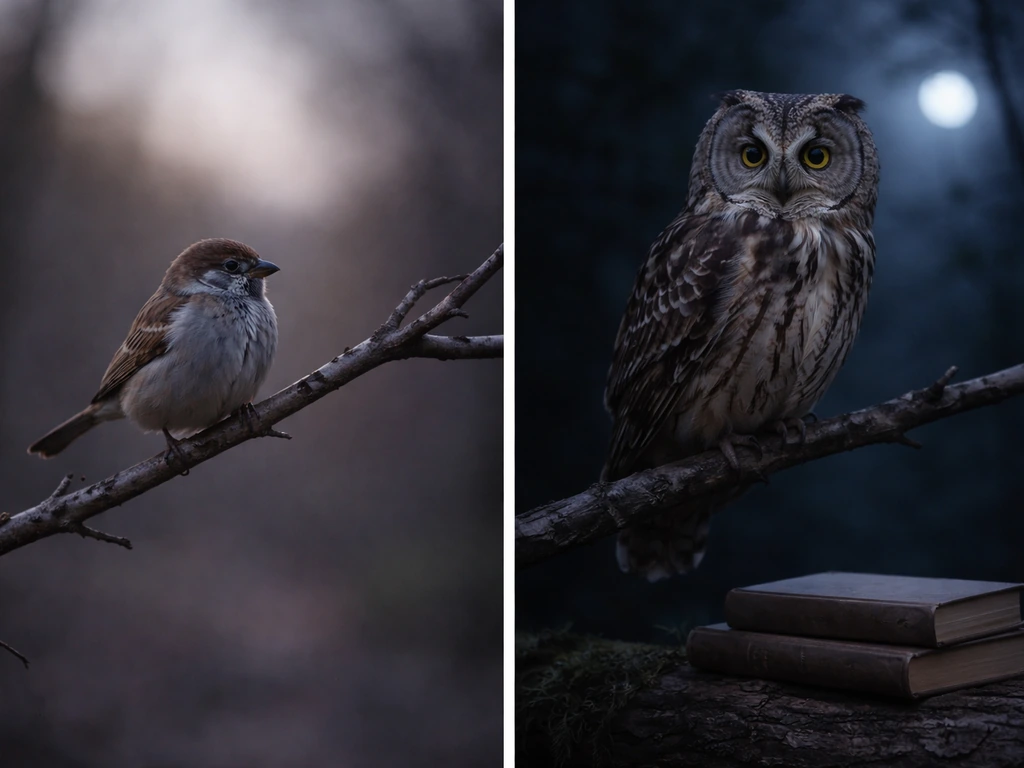
'Wise old owl' is the more specific version, directly tied to the owl's centuries-old reputation as the symbol of wisdom and learning. Owls appear in Greek mythology as companions of Athena, the goddess of wisdom, and that association has traveled through folklore, literature, and nursery rhymes all the way to modern usage. When someone says 'wise old owl,' they're leaning into that specific bird symbolism.
'Wise old bird' is the more general, looser version. It borrows the same warm, admiring energy but doesn't pin itself to any one species. It functions as the conversational shorthand. Interestingly, the nursery rhyme itself uses both: the poem is about an owl, but its concluding line calls the owl 'a wise old bird,' confirming that the two phrases are closely related variants rather than entirely separate expressions. Wikipedia notes explicitly that 'the wise old bird is a phrase which features in the nursery rhyme A Wise Old Owl,' making that connection official.
Where they differ in practice: 'wise old owl' tends to feel slightly more formal or literary, suited to written descriptions or careful characterizations. 'Wise old bird' feels more conversational and affectionate, the version you'd actually say out loud to someone's face. If you're writing a character who is a wise mentor, 'wise old owl' might appear in narration, while 'wise old bird' might be what another character calls them in dialogue.
Example sentences and how to use it in your own writing
Here are practical examples showing the phrase at work across different registers and uses.
- "You should ask Margaret about this. She's been in the industry for forty years. That woman is a wise old bird if I've ever met one." (spoken, admiring, informal)
- "The detective smiled. He'd seen that trick before. He was, after all, a wise old bird who didn't miss much." (narrative, character description)
- "Why can't we all be like that wise old bird?" (caption, meme, or social media, quoting the rhyme playfully)
- "He thought he could fool her, but she was no pushover. No wise old bird around to warn him was his first mistake." (literary, borrowing the Collins-style usage)
- "Alright, wise old bird, what do you think we should do?" (spoken, affectionate teasing, said to a friend who keeps being right)
For writers: the phrase works well in dialogue and informal narration. It doesn't belong in formal academic writing or professional reports, but it fits naturally in fiction, personal essays, memoirs, and casual nonfiction. It's also worth noting that the phrase reads as slightly dated or old-fashioned to younger audiences, which can be useful stylistically if you want to give a character a classic, unhurried voice. If you're also curious about the phrase's broader usage, you can look up geezer bird meaning next.
Related bird expressions people often confuse
A few other bird-based phrases are close enough in territory that they sometimes get muddled with 'wise old bird. If you're curious about the phrase itself, you might also look up the old bird meaning so you can compare how people use it in different contexts. ' Knowing how they differ keeps your usage sharp.
- Old bird: A broader, more neutral label for an older person, especially a woman. It can be neutral or affectionate depending on tone, but it doesn't carry the 'wise' or admiring layer on its own. Think of it as the base phrase that 'wise old bird' upgrades with a compliment.
- Tough old bird: This one emphasizes resilience and durability rather than wisdom or knowledge. A tough old bird has survived hard things. A wise old bird has learned from them. The two can overlap, but the emotional emphasis is different.
- Wise old owl: As covered above, this is the species-specific, slightly more formal version. Same admiring energy, but more literary and owl-centric.
- Early bird: Completely different territory. This is a proverb-based expression about being first, as in 'the early bird catches the worm.' No wisdom or age connotation, just timeliness.
- Birdbrain: The opposite end of the spectrum entirely. This is a slang insult meaning someone is foolish or scatterbrained. If you're looking for a contrast to underline why 'wise old bird' is a compliment, birdbrain is the clearest one.
- Wise bird: A more generic descriptive metaphor that turns up in modern writing (Psychology Today has used it as a headline, for instance) to describe any guiding or perceptive figure. Looser and less idiomatic than 'wise old bird.'
If you've come across 'old bird' or 'tough old bird' and landed here, those expressions are close cousins worth exploring separately. They share some DNA with 'wise old bird' but each one carves out its own distinct meaning and tone. People sometimes also search for the strut bird meaning, which is a different idea from wise old bird. So if you are wondering what stout bird meaning is, start with the same idea of a watchful, experienced person behind the words wise old bird.
FAQ
Is “wise old bird” always a compliment, or can it be about intelligence?
Often it is not a direct compliment about intelligence, it is more about good judgment and experience (someone who has seen outcomes and can predict what matters). If you want to praise thinking skills specifically, pairing it with “good judgment” or “street smarts” usually lands more clearly than relying only on “wise old bird.”
When is “wise old bird” most likely to feel rude or ageist?
If you say it to a much older person, especially in a one-on-one setting, the risk is usually low because the phrase carries affection. The main exception is using heavy focus on “old” or saying it publicly when the person already feels judged, in which case it can read as teasing at their age rather than their wisdom.
Who is it appropriate to describe as a “wise old bird” (and who is it not)?
In most everyday speech, “wise old bird” works well for describing a mentor, grandparent, or seasoned coworker. It feels mismatched for describing a child, a new employee, or someone who is young and still learning, unless the speaker is intentionally writing a playful exaggeration.
How can I phrase it so it sounds affectionate instead of sarcastic?
To keep the tone gentle, match it with positive body language, and keep the phrase short (for example, “You, wise old bird,” or “Looks like you’re the wise old bird”). If you add mocking wording like “still not listening,” “wise” can flip into sarcasm, even if “bird” suggests warmth.
Can I use “wise old bird” in professional or academic writing?
Yes. In formal writing such as reports, performance reviews, or legal correspondence, it typically reads casual or dated. For professional contexts, safer alternatives are “experienced,” “astute,” “seasoned,” or “reliable judgment,” and you can reserve “wise old bird” for dialogue or character voice.
Does “wise old bird” ever clash with situations like criticism or correction?
It is usually not meant to imply someone is old in a negative way, like “past it,” but it can if the surrounding context is critical. If you are correcting someone, using “wise old bird” can undercut the correction by making it sound like you are praising while disagreeing.
Should I say “wise old bird” or “wise old owl,” and how do I choose?
“Wise old owl” is the more species-specific version that leans slightly literary. If you want the exact nursery-rhyme association or a more storybook feel, “wise old owl” fits better. If you want everyday, conversational warmth without the owl imagery, “wise old bird” is the looser option.
What is the difference between “wise old bird” and just “old bird”?
Don’t confuse it with “old bird” alone. “Old bird” can be read as wary or seasoned, but it does not automatically include the “wise” warmth. Adding “wise” shifts it toward admiration and practical judgment.
How is “wise old bird meaning” used differently on social media than in conversation?
You will sometimes see “wise old bird” as a meme caption, often paired with owl or bird images, where it signals calm confidence. If the post is about someone’s advice, the phrase reads admiring; if it is paired with failure or controversy, it can become sarcastic, so read the surrounding text and comments.
Next Article
Geezer Bird Meaning: What It Means and How It’s Used
Explains geezer bird meaning, common uses in conversation, possible origins, context clues, and example sentences.