To give the bird means to make an offensive gesture by raising your middle finger at someone, keeping the other fingers folded down. If you're wondering about the Portlandia line that plays on this, portlandia put a bird on it meaning is essentially the same idea of giving someone the bird as a rude insult.
To Give the Bird Idiom Meaning and Usage Examples

Marcus Reeves
12 May 2026
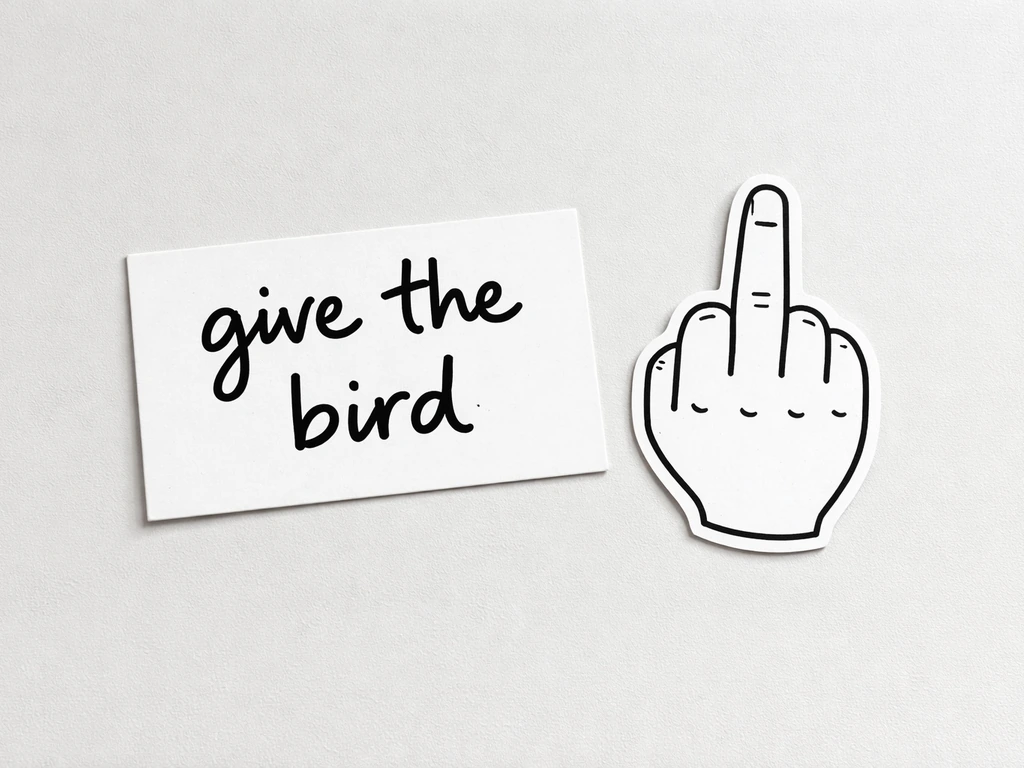
In the United States, that's the primary meaning and it's essentially identical to "flip the bird. " [In British English, the phrase has a second, older meaning: to boo, jeer, or loudly express disapproval at someone, especially a performer on stage. ](https://en. wiktionary.
org/wiki/givethebird) So the idiom has two lanes depending on where and how it's used, but both share the same spirit of telling someone they're not welcome.
The exact idiom and how people spell it
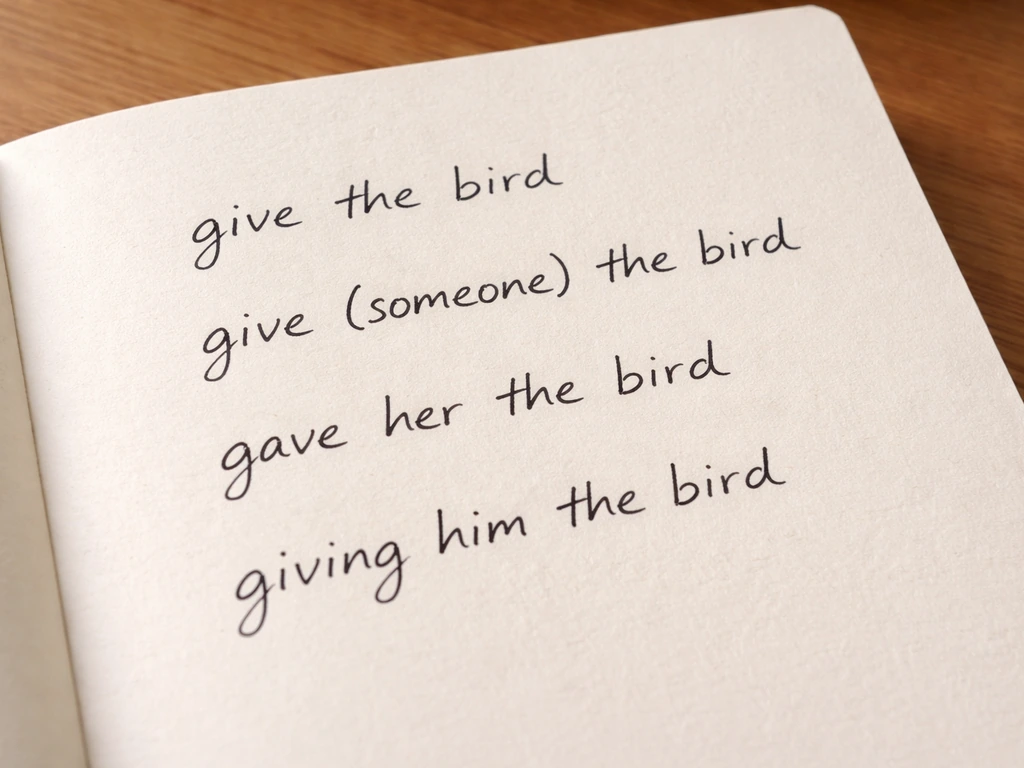
The standard form is "give (someone) the bird" or "give the bird. " You'll also see it written as "giving him the bird," "gave her the bird," or the closely related "flip the bird. " People searching for this phrase often type "to get the bird idiom meaning" (that's the passive version, as in receiving the gesture or the jeering), and some write "give a bird" or "give someone a bird," which are garbled versions of the same thing.
The idiom always uses "the" before "bird," not "a," because it refers to a specific, understood gesture or act rather than a random bird. If you're seeing "get the bird" in a British context, it usually means someone was booed or dismissed, not that they performed the gesture themselves.
What the idiom actually means in plain English
In everyday American English, "to give someone the bird" means to extend your middle finger at them as a rude, dismissive, or angry insult. It communicates something along the lines of "go to hell" or "up yours" without saying a word. The gesture is universally understood in the US as deeply offensive, and using the phrase in conversation carries that same weight.
The British meaning is distinct but related in spirit. In UK English, "give the bird" (or "get the bird") traces back to theatrical slang. When an audience hated a performer, they'd hiss, boo, and jeer. The hissing sound echoed the noise a goose makes, and the goose became slang for that collective disapproval. Over time, "giving someone the bird" came to mean expressing loud public displeasure at them. So a comedian who bombs might be said to have "gotten the bird" from the crowd. It's the same hostility as the American version, just delivered vocally rather than physically.
Where the phrase comes from

The British theatrical origin is well-documented. Historical slang records describe "the big bird" as the goose, an animal that hisses when agitated. Audiences hissing at bad performances were said to be "giving the big bird," and the phrase shortened over time to "give the bird." The American middle-finger meaning developed separately but borrowed the same slang structure. By the mid-20th century, the gesture meaning had fused with the phrase, and the two meanings coexisted across different dialects of English. Wikipedia's entry on taunting traces the middle-finger connection partly to the 1860s expression "give the big bird," later blending with the direct "up yours" hand gesture.
Context clues: tone, situation, and who it's aimed at
The tone is almost always hostile, dismissive, or comedic, depending on the situation. When someone gives another person the bird in a road-rage moment, it's pure anger. When it appears in a comedy or action movie, it usually gets a laugh because the directness of the gesture is so blunt. In British usage, the theatrical or performance context is a reliable flag: if the sentence involves a crowd, audience, or performer, you're almost certainly looking at the booing/jeering meaning.
The phrase is always directed at a person or group. You give the bird to someone, not at a situation or object. That target structure helps you identify it quickly. The person or group receiving it is being told, in no uncertain terms, that they are not respected, not wanted, or not liked.
The phrase in action: example sentences

Here are some real-life style and media-style examples that show how the phrase works across different tones: If you're trying to understand the a goal bird idiom meaning, focus on whether it describes the middle-finger insult or the British booing/jeering disapproval sense.
- Everyday/angry: "The driver cut me off and I gave him the bird before I even knew what I was doing."
- Casual/comedic: "She gave the whole meeting room the bird and walked out, which honestly made everyone respect her more."
- Media reference (Top Gun, 1986): In the film, Maverick describes his aerial encounter by saying "Keeping up foreign relations. You know, giving him the bird!" while making the middle-finger gesture, a line that became one of the most quoted examples of the phrase in popular culture.
- British/theatrical: "The crowd gave the opening act the bird after the third badly received song."
- Figurative: "His resignation letter was essentially giving the company the bird in formal language."
Notice that in the figurative example, no actual gesture happens. Because the phrase can be figurative, people sometimes discuss its proverbial bird in the punch bowl meaning without describing the gesture at all figurative example. The phrase can be used metaphorically to describe any act of blunt defiance or dismissal, which is why you'll sometimes encounter it in writing about politics, sports, or business where no literal finger is involved.
How this differs from similar bird idioms
A few phrases trip people up when they're searching for this one. For a related but different angle on how the word bird is used in pop culture slang, see kingpin meaning bird. Here's how "give the bird" sits differently from its neighbors: In contrast, "bolt the bird" is often confused with other bird-idiom phrases, but it is not the same as "give the bird" meaning bolt the bird meaning.
| Phrase | Meaning | Tone | Gesture involved? |
|---|---|---|---|
| Give (someone) the bird | Middle-finger gesture (US) or booing/jeering (UK) | Hostile or dismissive | Yes (US) / No (UK) |
| Flip the bird | Raise the middle finger at someone | Hostile or comedic | Yes |
| Flip someone off | Same as flip the bird | Hostile or comedic | Yes |
| A bird in hand | It's better to keep what you have than risk it for something more | Cautionary/practical | No |
| Early bird gets the worm | Acting early gives you an advantage | Motivational | No |
| Bird-brained | Describing someone as silly or not very smart | Mildly insulting | No |
"Flip the bird" and "give the bird" are essentially interchangeable in American English. If you see either one, you're looking at the same gesture. "Flip someone off" is also in the same family. None of the others ("a bird in hand," "early bird gets the worm," "bird-brained") share any meaning with this phrase, even though they all involve the word bird. The site covers many of those expressions separately, and it's worth noting that bird idioms span a huge range from wise proverbs to outright insults, so context always matters.
How to pin down the meaning when you only have a quote
If you've run across the phrase in a quote and aren't sure which meaning applies, run through these quick checks:
- Check the setting. Is there an audience, crowd, or performance context? If yes, the UK/theatrical booing meaning is likely, especially in older or British texts.
- Look for a physical description. Words like "hand," "finger," "gesture," or an action verb nearby ("he raised," "she stuck up") signal the middle-finger meaning.
- Consider the source's dialect. American film, TV, or casual writing almost always uses the gesture meaning. British books, theater reviews, or older texts lean toward the jeering meaning.
- Check who's doing it. If it's one person doing it to another person directly, it's almost always the gesture. If it's a group doing it to a performer or public figure, it leans toward booing.
- Look up the surrounding scene. For movie quotes especially, a quick search for the scene often shows whether a hand gesture is involved, which settles it immediately.
The Top Gun example is a good case study: you might read the line cold and wonder what "giving him the bird" means, but the scene makes it obvious because it's one character doing something physical to another. That physical, one-on-one dynamic almost always means the middle-finger meaning in American usage. If you're ever unsure, Merriam-Webster and Cambridge Dictionary both have clear, current entries for the phrase that confirm which sense applies, and they separate the US and UK meanings explicitly.
FAQ
Is “give the bird” always a physical middle-finger gesture in America?
Most of the time yes, but the phrase can also appear figuratively in writing and dialogue, meaning blunt dismissal or defiance without describing any hand motion. If the sentence mentions a crowd, boos, a performer, or stage context, switch to the British booing meaning instead.
What does “get the bird” mean, and does it differ from “give the bird”?
“Get the bird” focuses on the recipient, in both dialects. In the US it means someone was shown the gesture, while in the UK it typically means the person was booed or hissed at. “Give” emphasizes the action by the speaker, “get” emphasizes who received it.
How should I interpret the phrase if it appears in a movie or TV script with no explicit gesture shown?
Treat it as a strong cue that the line signals hostility even if the camera does not show the hand clearly. In American scenes, it usually implies the middle finger directed at a character, and in British scenes tied to audiences, it usually implies booing or jeering.
Can “give the bird” be used politely or playfully?
Not really. Even when used comedically, it is still hostile or dismissive in intent. If you want a non-offensive alternative, use softer verbs like “tell someone off,” “give someone a rude remark,” or “boo” (UK performance contexts only).
Is “give a bird” or “give someone a bird” correct?
No, those forms are usually incorrect or garbled. The idiom is normally “give the bird” or “give (someone) the bird,” with “the” because it refers to a specific, recognized insult or disapproval act.
What about the passive form, “to get the bird,” in American English?
In American usage, “get the bird” generally means you received the middle-finger gesture from someone else. It can also be metaphorical, but the subject being targeted should be a person or group.
If someone says “flip the bird” instead of “give the bird,” is the meaning the same?
In American English, yes, they are essentially interchangeable for the middle-finger insult. Both typically carry the same level of offensiveness, so you should not treat “flip” as a milder variant.
Does the idiom ever mean something positive, like “bird” as a metaphor?
No. With “give the bird,” the core meaning is negative, rejection, or public disapproval. Other “bird” idioms (like “early bird” or “bird-brained”) are unrelated and should not be mixed with this phrase.
How can I tell whether the speaker means US middle-finger or UK booing/jeering?
Use the context. If it’s one person doing something directly to another in a one-on-one moment, it points to the US gesture. If the sentence includes an audience, performer, show, crowd noise, or stage performance, it points to the UK booing and jeering sense.
Are there safe substitutions I can use instead of “give the bird” in formal writing?
Yes. For the US meaning, consider “show someone the middle finger,” “tell someone off,” or “use a highly offensive gesture,” depending on how explicit you need to be. For the UK meaning, “boo,” “jeer,” or “hiss at a performer” works when you are describing crowd behavior.
Next Article
Kingpin Meaning Bird: What It Likely Means and How to Tell
Decode what kingpin means when linked to a bird: species, nicknames, characters, slang, and how to identify it in contex