When someone says 'bird,' they almost always mean one of three things: the literal animal, a slang term for a person (most commonly a woman, in British English), or a shorthand inside a phrase like 'flip the bird' or 'a bird in the hand.' Which meaning fits depends almost entirely on context, and once you know the patterns, it becomes pretty easy to read. Here's a full breakdown of every common use, so you can decode it wherever you're seeing it. Here's a full breakdown of every common use, so you can decode it wherever you're seeing it what do you mean a bird.
What Does the Name Bird Mean? Literal, Slang, Idioms

Marcus Reeves
16 May 2026
The everyday meaning of 'bird'
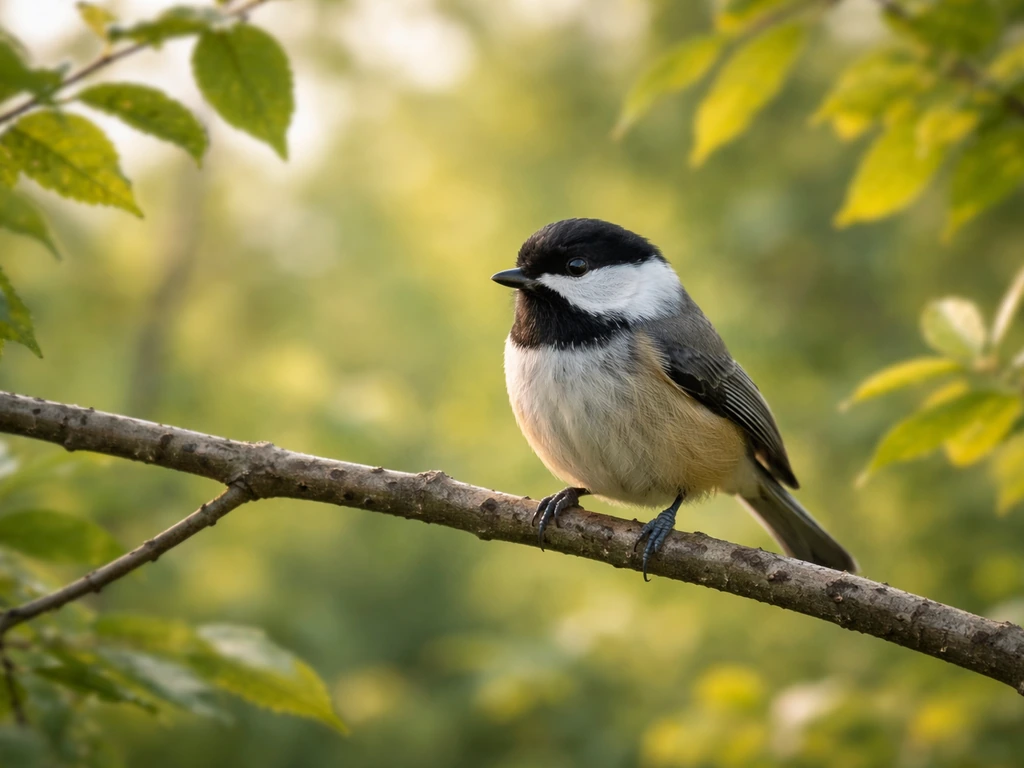
At its most basic, a bird is a feathered, warm-blooded animal that lays eggs. That's the primary definition you'll find in Merriam-Webster, and it's the one most people default to. When someone says 'there's a bird at the feeder' or 'that's a rare bird,' they're almost certainly talking about the actual animal. The word has been in English since before the 12th century and has always carried this core meaning first.
What makes 'bird' interesting is that the word branched off in so many directions from that animal root. Once you understand that every slang use and every idiom grew out of this literal meaning, the extended uses start to make more intuitive sense. A 'jailbird' is a person caged like a bird. A 'bird's-eye view' comes from the angle a flying bird would have. The animal is always the origin point, even when the meaning has traveled far from it.
Slang meanings: when 'bird' refers to a person
In British slang, 'bird' has long been used to refer to a woman, particularly a young woman. Cambridge explicitly labels this as UK slang. You'll hear it in British TV shows, music, and conversation, and it reads as roughly neutral to mildly familiar depending on tone. It's not universally considered flattering, but it's also not automatically hostile. Think of it like how Americans might use 'chick' in informal speech, with similar baggage attached.
Beyond the gender-specific slang, 'bird' can refer to any person in a slightly detached or colorful way. Dictionary.com includes an informal person-referent sense, and you'll also find compound slang built on it. A 'jailbird' is someone who has been in prison. A 'jaybird' can mean someone who talks too much, or informally, a novice or simpleton. A related example is “jaybird,” which Wikipedia describes as a slang term meaning a person who talks a lot or a novice/simpleton, showing how bird-words can become person-referent slang a 'jaybird' can mean someone who talks too much, or informally, a novice or simpleton.. When you see bird-words used to describe people, they often carry a note of mild mockery or character commentary.
The tone is what tells you how to read it. Someone calling a friend 'you old bird' is being affectionate. Someone calling a stranger 'that strange bird' is being observational or dismissive. If it's used alongside a name or a gesture of warmth, it's friendly. If the tone is flat or cutting, it's more likely a put-down. Context and delivery are everything here.
Idioms and set phrases using 'bird' (and what they actually mean)
This is where most of the confusion happens. 'Bird' appears in a lot of fixed phrases, and the meaning of the phrase has almost nothing to do with actual birds. Here are the ones you're most likely to run into:
| Phrase | What it means | When you'd use it |
|---|---|---|
| Flip the bird | To raise your middle finger as a rude gesture toward someone | Describing or doing something offensive/insulting toward another person |
| A bird in the hand is worth two in the bush | What you already have is more valuable than what you might get | Advising someone to appreciate a sure thing over a risky gamble |
| Early bird gets the worm | The person who acts first has an advantage | Encouraging someone to show up early or act quickly; also used to describe an early riser |
| Birds of a feather flock together | People with similar traits or interests tend to group together | Commenting on why certain people hang out or are alike |
| A little bird told me | Someone gave me this information in secret (the source stays anonymous) | Sharing gossip or information without revealing who told you |
| Bird-dog | To watch closely or doggedly seek something out | Describing someone who tracks or monitors something relentlessly |
'Flip the bird' is worth singling out because it's so commonly misread in text. It refers purely to the middle-finger gesture. Merriam-Webster lists it as a fixed idiom, and an earliest printed use of the phrase appears in a 1967 publication. It's not subtle, and the context around it is almost always conflict or frustration.
'Early bird' is a good example of an idiom that also became standalone slang. Dictionary.com notes the proverb was first recorded in English in 1605, but today 'early bird' on its own just means someone who wakes up or arrives early. You'll see it in phrases like 'early bird discount' or 'I'm an early bird' with no idiom intended at all. The proverb just became a personality description.
'A bird in the hand is worth two in the bush' is advice, pure and simple. If someone uses it in conversation, they're telling you not to give up a guaranteed outcome for a speculative one. Cambridge's explanation emphasizes the contrast between certainty and uncertainty, and that's exactly the situation it's meant for.
What 'bird' symbolizes in culture and literature
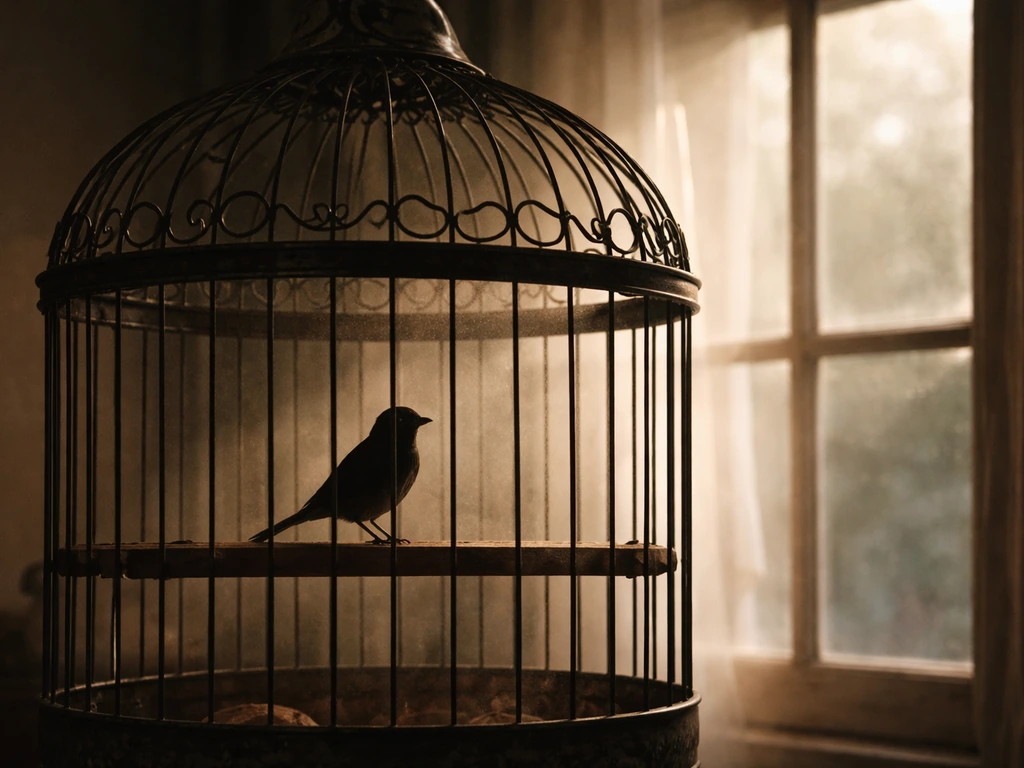
Birds as a category carry rich symbolic weight in literature, art, and culture, though the meaning shifts a lot depending on which tradition you're looking at. In general, birds in literature tend to symbolize freedom, the soul, or a messenger between worlds because they can fly between earth and sky. That's the broad, non-specific reading. Once you zoom into individual species, the symbolism gets much more precise.
In Western literary tradition, the image of a caged bird almost always signals lost freedom or oppressed potential. A bird in flight suggests liberation or escape. These are the broad strokes that show up everywhere from ancient poetry to modern novels, and they hold pretty consistently across cultures.
Species-specific meanings: when the bird name itself carries the message
When someone mentions a specific bird rather than 'bird' in general, the symbolism often shifts dramatically. Here's how to read the most common ones:
Dove
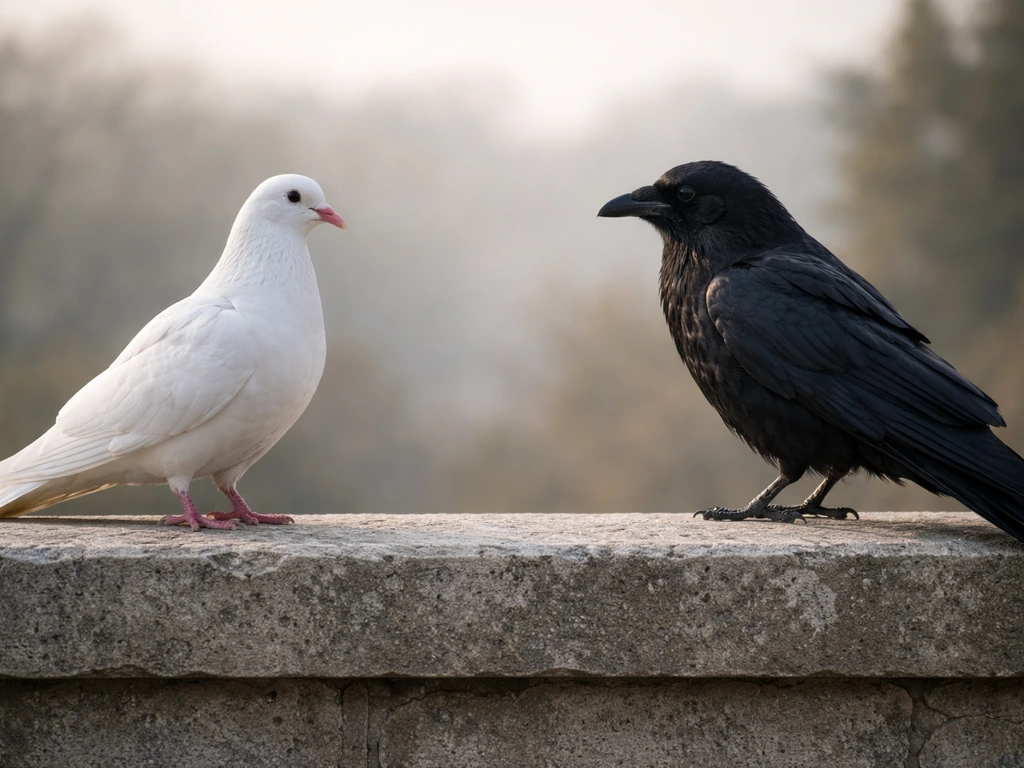
The dove is one of the most universally understood symbols in the English-speaking world. It represents peace, purity, and the Holy Spirit in Christian tradition. The connection goes back to the Bible, where a dove returns to Noah with an olive branch, and to Jesus' baptism, where the Spirit of God descends in the form of a dove. Today 'releasing doves' at weddings or funerals carries that same symbolic weight. If someone says 'she's a dove' or uses a dove image, peace and gentleness are almost certainly the intended read.
Raven
The raven means something almost opposite. In Western culture, it's strongly associated with death, omens, and the supernatural, largely because of Edgar Allan Poe's 1845 poem 'The Raven,' which cemented the bird's dark reputation in literary culture. Poe drew on existing folklore about ravens as ill omens, and that image stuck hard. When you see a raven in a story, expect foreboding. When someone references 'the raven,' they're almost always invoking that gothic, ominous energy.
Owl
The owl is the go-to symbol for wisdom, and that connection goes back to ancient Greece, where Athena, goddess of wisdom, had the owl as her emblem. The symbolism survived through the centuries and is still active today: owls appear on academic logos, in fantasy literature as wise guides, and in casual conversation ('she's a wise old owl'). The Owl Pages notes that even as superstitions around owls faded in the 20th century, the wisdom association bounced back and stayed dominant in modern Western culture.
When someone says 'the bird' without a species
If someone says 'the bird' with a definite article and no other context, they're probably using it as shorthand for 'flip the bird' (the middle finger gesture) or referring to a specific bird already established in the conversation. It's rarely symbolic on its own. If the conversation is tense or involves conflict, assume the gesture meaning. If it follows a reference to an animal, it's probably still the animal.
Related expressions and other ways 'bird' shows up
Beyond the major idioms, 'bird' turns up in a lot of smaller, context-specific ways that are worth knowing:
- Pet/animal context: 'My bird' almost always means a pet parrot, budgie, or other caged bird. This is the most literal use you'll encounter in casual conversation about home life.
- Prison slang: 'Bird' and 'birdcage' both appear in prison-related slang, connecting back to the caged-bird metaphor for inmates. 'Jailbird' is the most widely used form and is understood well outside prison culture.
- Flirty or jokey uses: In British English, calling someone 'a bit of a bird' can be playful or flirtatious depending on tone. It's generational and fading, but you'll still hear it in older UK media.
- Bird-dogging: To 'bird-dog' someone is to watch them closely or pursue something relentlessly. Merriam-Webster traces this to early 20th-century American English, and by the 1930s it was even used to describe someone who poaches another person's date.
- Warning uses: 'Bird' sometimes appears in compound warnings or observations ('that's a rare bird,' 'odd bird') where it signals that a person or thing is unusual or hard to categorize.
How to tell which meaning someone intends
The fastest way to decode 'bird' in any context is to run through three quick checks. First, is there a specific species name? If yes, go to the species symbolism. Second, is it inside a recognizable phrase like 'flip the bird' or 'early bird'? If yes, it's an idiom and the literal animal doesn't apply. Third, is it used to describe a person with a hint of humor, affection, or mild contempt? If yes, it's slang and the tone tells you the attitude behind it.
- Specific species mentioned (dove, raven, owl, etc.) = symbolic or literal animal meaning tied to that species
- Inside a fixed phrase ('flip the bird,' 'a bird in the hand,' 'birds of a feather') = idiom, not literal
- Describing a person with emotional tone = slang, read the tone to get the attitude
- Standalone with 'the' in a tense conversation = probably 'flip the bird' as the gesture
- In a home/pet context = almost certainly a pet bird (parrot, budgie, canary, etc.)
- Alone with no other context = default to the literal animal meaning
If you're exploring the broader question of what 'bird' means at a definitional level, it's worth knowing that the denotative and connotative meanings of the word are quite different territory. The denotative meaning sticks close to the animal, while the connotative meaning of 'bird' opens up into freedom, fragility, surveillance (as in 'bird-dogging'), and even insult. Those layers are worth understanding separately, especially if you're writing or analyzing text where the choice of 'bird' over another word was deliberate.
The bottom line: 'bird' is one of those words that punches above its weight in English. It's literal, figurative, slangy, symbolic, and idiomatic all at once, and the context almost always makes the meaning clear once you know what to look for. When in doubt, check the phrase it's sitting in first, then the tone, then the species. That order will get you to the right answer almost every time.
FAQ
If someone says “bird” in a text message, how can I tell whether it means the animal, slang, or “flip the bird”?
Look for cues before the word itself. If there is any mention of conflict, argument, or anger, “bird” is very likely shorthand for the middle-finger gesture. If it is part of a phrase like “early bird,” “bird in the hand,” or “flip the bird,” follow the fixed-phrase meaning. If it is used as a tag for a person (for example “you old bird” in a friendly message), it is probably British-style slang and the tone matters most.
What does “bird” mean in the phrase “bird-dogging,” and is it related to the animal sense?
In “bird-dogging,” the meaning shifts toward surveillance and persistent following, not literal birds. The term uses “bird” as shorthand for tracking someone or something closely. The bird imagery is about keeping eyes on the target, not about avian symbolism.
Does “bird” as slang for a woman carry the same meaning in the US as it does in the UK?
No. The woman-referent slang is specifically associated with British English. In the US, “bird” used for a person is less standard and can sound dated, regionally specific, or more insulting depending on the speaker and audience. If you are not in a UK context, default to other meanings unless the surrounding text clearly indicates otherwise.
Is “you old bird” always affectionate, or can it be insulting?
It can be either. Many uses are affectionate or lightly teasing, especially if it comes with warmth (compliments, shared context, flirty tone). If it is delivered coldly, with criticism, or aimed at embarrassing someone, it can read as a put-down or mocking observation. Tone and relationship (friendship vs. confrontation) decide the direction.
What does it mean when someone says “the bird” with no other context?
Usually it points back to something already established, most commonly a reference to “flip the bird” in tense situations. If the conversation has been about an object, a person, or a specific animal earlier, “the bird” can also simply mean that previously mentioned bird. If there is no prior referent and the scene is tense, treat it as gesture shorthand.
Is “early bird” always an idiom, or can it be literal?
It can be both. If it is used as a standalone label like “I’m an early bird” or “early bird discount,” it often functions as ordinary description for someone who wakes up early or arrives early. Only treat it as the full proverb meaning if the sentence is clearly about advice or the value of acting sooner.
How should I interpret “jaybird” when it is used about someone?
“Jaybird” commonly appears as slang that can mean a talkative person, or it can refer to an inexperienced or simple person. Which one fits depends on whether the rest of the sentence points to chatting or to naivety. Context is important because “jay” imagery can swing between “blabbermouth” and “novice” readings.
When “dove,” “raven,” or “owl” are mentioned, is the symbolism always the same?
In English-speaking Western contexts, the broad associations are fairly consistent: dove for peace and gentleness, raven for dark omens, and owl for wisdom. However, stories can subvert expectations, so check whether the surrounding lines support the usual symbolism or intentionally contradict it. If the author gives explicit cues, they override the default cultural reading.
What does it mean if a writer uses “bird” to sound more metaphorical than literal?
That is likely connotative meaning, not just the animal definition. In text analysis or writing, “bird” can be chosen to suggest freedom, vulnerability, being watched, or a slightly insulting edge, depending on the phrase and nearby wording. If you are interpreting a passage, focus on what the sentence emphasizes (escape, captivity, observation, or mockery) rather than the literal word alone.
Next Article
Thirst Reckoned Bird North Meaning Explained and Decoded
Decode the riddle phrase thirst reckoned bird north meaning: idioms, symbolism, and direction clues to find likely inten