
"Dolly bird" is British slang for a pretty, stylish young woman. It has nothing to do with an actual bird. The phrase peaked in the 1960s during the Swinging London era, and while you can still encounter it today, it carries a strong period flavour and is generally considered outdated. If you ran across it in a book, a TV script, or a conversation and weren't sure whether someone was talking about a person or an animal, the answer is almost always a person.
Dolly Bird Meaning: Definition, Use, and Context

Marcus Reeves
19 Apr 2026

Quick definition
Merriam-Webster defines "dolly bird" (labeled British) as "a pretty young woman." Cambridge Dictionary echoes that: British slang, pretty young woman. Green's Dictionary of Slang adds a bit more texture, describing a dolly bird as an attractive and stylish young woman, typically in her late teens or early twenties, associated with the Carnaby Street and King's Road scene of the 1960s. The first known use in print is 1964, though some sources suggest the "dolly" component was applied to attractive young women even earlier in the twentieth century.
Literal bird or slang term? Spoiler: it's slang
There is no bird species called a dolly bird. If you searched for one, you won't find it in any ornithology guide. The word "bird" here is doing slang work: in British English, "bird" has long been used as informal shorthand for a girl or woman (think "she's a nice bird" in mid-century British speech). "Dolly" layers on the sense of something cute, fashionable, and a bit doll-like. Put them together and you get a colloquial compliment, not a creature with feathers.
This is worth flagging because the site covers plenty of phrases where "bird" does refer to an actual bird (or to something more ambiguous). "Dolly bird" is firmly in the slang-for-person camp. Contrast it with phrases like "dicky bird," which can refer to a literal small bird used in baby talk, or to the Cockney rhyming slang meaning of "word" (as in "not a dicky bird," meaning not a word, meaning silence). Those are different phrase families with different origins and meanings, even though they share the word "bird."
How it usually lands: tone and connotations
In its 1960s heyday, "dolly bird" was meant as a compliment, even an admiring one. Merriam-Webster groups it with synonyms like "beauty queen" and "goddess," which gives you a sense of the original warmth behind it. It was playful, fashionable, slightly cheeky, and used by people who thought they were being flattering. The phrase was tied to a specific image: a young woman in a mini skirt, eyeliner, and boots, very much part of the mod aesthetic of Swinging London.
Today, the tone is more complicated. WordWeb explicitly flags the term as outdated and potentially offensive, and that's a fair warning. The phrase reduces a woman to her looks and youth in a way that feels more objectifying than charming to most modern ears. When you encounter it now, it's usually one of three things: someone deliberately evoking a 1960s atmosphere, an older speaker using language from their generation, or an ironic or critical use that comments on that old-fashioned attitude. The original affectionate intent doesn't erase the fact that the framing is dated.
Usage examples in real sentences
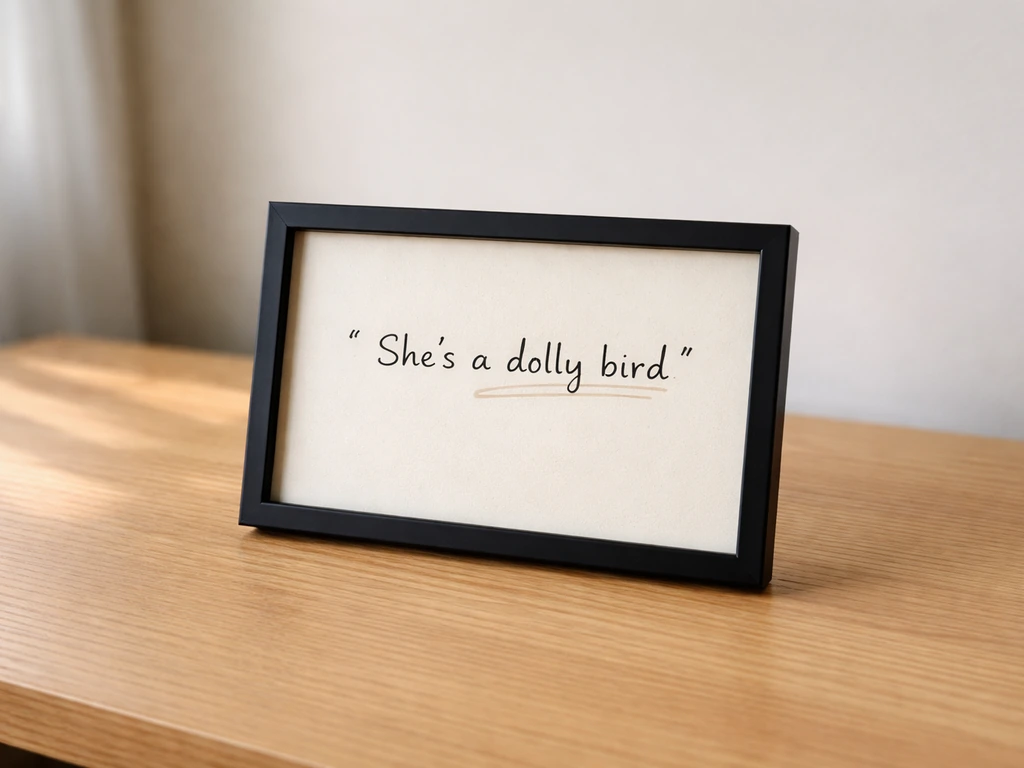
Seeing the phrase in action makes the meaning click faster than any definition. Here are some concrete examples of how "dolly bird" actually appears in dialogue and writing:
- "She's a dolly bird." (From a BBC Writers Room script, used as a character description in dialogue, referring to a woman, not any kind of animal.)
- "Back in the swinging '60s she was one of London's most celebrated dolly birds." (Merriam-Webster example sentence, clearly a nostalgic cultural reference to fashionable women of the era.)
- "She's been a grunge angel, a dolly bird..." (Merriam-Webster web example, using dolly bird as one label in a list describing a woman's style phases over time.)
- "Mini-Culotte Set from the Dolly Bird Boutique." (A 1967 magazine ad using the phrase as a fashion brand name, showing how it was used as a cultural label during its peak period.)
Notice that in every case the reference is to a woman or a brand aimed at young women. A 1967 Rave Magazine PDF includes the commercial phrase “blank" rel="noopener noreferrer">Mini-Culotte Set from the Dolly Bird Boutique,” illustrating period branding usage. If you’re also wondering about “dairy bird” specifically, the dairy bird meaning can vary by context, so it’s worth checking that separate usage before assuming it’s the same kind of slang as dolly bird. No feathers, no beaks, no wildlife involved.
Where you'll find it: literature, culture, and everyday slang
British pop culture and film
The phrase is most at home in British cinema and television from the 1960s and 1970s. Academic research on Swinging London cinema specifically uses "swinging dolly bird" as a cultural figure of that era. If you're watching a period drama set in London during that decade, you're very likely to hear it. It signals a specific time and place more than it simply describes a person.
Fashion and branding
The 1967 magazine scan of the "Dolly Bird Boutique" shows that the phrase was also picked up as commercial branding. Shops, clothing lines, and magazines aimed at young fashionable women used it as a selling point during its peak years. That commercial usage reinforced its association with mod fashion and youth culture.
Contemporary usage and music
You still see the phrase in modern writing, usually when authors want to evoke a 1960s mood or comment on that era's attitudes toward women. It also turns up as a proper noun in titles, such as a music track called "Dolly Bird," where the phrase functions as a name or aesthetic reference rather than a direct slang description. When it's a title rather than a phrase in dialogue or prose, the slang meaning may be intentionally invoked, purely decorative, or somewhere in between.
How to tell what it means from context

If you're reading or watching something and "dolly bird" appears, a few quick checks will tell you exactly what you're dealing with:
| Context clue | What it suggests |
|---|---|
| The text is set in or references 1960s Britain, mod fashion, or Swinging London | Classic slang use, referring to an attractive stylish young woman of that era |
| The word is used in dialogue to describe a named woman or a character on screen | Straight slang, person reference, not a bird |
| The surrounding text is modern and critical in tone | Likely ironic or commentary on outdated attitudes, still referring to a woman |
| "Bird" elsewhere in the same text refers to a girl or woman | Confirms the slang register, dolly bird means the same thing |
| The phrase appears as a title, brand name, or proper noun | Aesthetic or naming use, may borrow the slang connotation or simply use it as a label |
| The text involves nature, wildlife, or ornithology | Extremely unlikely to mean dolly bird in the slang sense, check if it's a different phrase entirely |
The practical shortcut: ask whether "bird" in the surrounding text is being used as slang for a girl or woman. If yes, "dolly bird" almost certainly means an attractive young woman. Some readers also search for the maids a milking bird meaning, which is a different kind of phrase entirely. If the whole passage is about actual birds and nature, you may be dealing with a different phrase or a misread, and it's worth double-checking the source.
Period and geography are your other two big clues. "Dolly bird" is British, not American. If the text is set in the United States or uses American idioms throughout, hearing "dolly bird" would be unusual and probably deliberate (either as an affectation, a cultural reference, or a quotation). And if the time period is clearly the 1960s or 1970s, you're squarely in the era where the phrase was live slang rather than a period curiosity.
Similar phrases and how dolly bird compares
It helps to know how "dolly bird" sits alongside other bird-related slang so you're not mixing them up. The sibling phrases covered elsewhere on this site mostly work differently. "Dicky bird" (or dickey bird) can mean a small bird in child-directed speech, or it can mean "word" in Cockney rhyming slang, as in the phrase "not a dicky bird" meaning not a word, or silence.
In that Cockney rhyming slang sense, “dicky bird” can show up in the phrase “not a dicky bird,” meaning not a word or silence. Dickey bird define can also vary by context, since the phrase may be literal baby talk or a Cockney rhyming slang stand-in for “word. ”. The dicky bird meaning depends on which sense is intended, either a literal small bird in baby talk or Cockney rhyming slang for “word.
If you meant the phrase “dicky bird” instead, its meaning depends on whether it is literal baby talk or Cockney rhyming slang dicky bird meaning. ”. Those meanings have nothing to do with attractiveness or fashion. Similarly, phrases like "the dinky bird" come from a completely different tradition, rooted in literature rather than 1960s British street slang.
In contrast, the dinky bird meaning comes from a different tradition and is not tied to the 1960s slang sense of dolly bird.
The common thread is that "bird" in British slang is flexible: it can mean a literal bird, a girl or woman, or a rhyming stand-in for an entirely unrelated word. Knowing which register you're in makes all the difference. "Dolly bird" is always in the "attractive young woman" register, full stop. It never means silence, it never means a small sparrow, and it never refers to a species. Once you have that anchor, the rest is just about reading the room for tone: affectionate nostalgia, gentle teasing, or critical commentary on a phrase that most people now recognize as belonging to a different era.
FAQ
Does “dolly bird” always mean the same thing, or can it shift by context?
It is very stable in meaning, in British slang it means an attractive, stylish young woman. The main shift you will see is tone (admiring, teasing, or critical), not the core referent. If the passage clearly aims at jewelry, clothing, or a beauty figure, it still points to a person or a youth-fashion image, not an animal.
How can I tell whether “bird” is slang or literal in a text I am reading?
Look for nearby cues like references to “she,” “her,” dating, fashion items, nightlife, or compliments. Literal-bird usage will usually include habitats, actions like nesting or flying, or names of species. If the surrounding sentence reads like social commentary or characterization, “bird” is almost certainly slang for a woman.
Is “dolly bird” offensive today, and is it ever safe to use?
Modern ears often find it objectifying because it ties attractiveness to youth. Many writers use it only when evoking the 1960s or quoting an older voice. If you are not deliberately creating period authenticity, it is safer to avoid it in everyday speech.
What age does the phrase imply when it refers to a “dolly bird”?
Dictionaries and slang guides commonly place the implied age around late teens to early twenties, consistent with the Swinging London youth-culture image. If you see it applied to a much older character, it may be ironic, stylized, or part of an intentionally anachronistic joke.
Is “dolly bird” British only, and would an American speaker use it correctly?
The phrase is strongly associated with British slang. You might see it in American media as a quotation or period reference, but an American speaker using it casually would sound stylized or mimicry. In an American setting without a clear 1960s reference, treat it as likely an affectation or deliberate cultural callback.
What if I see “Dolly Bird” capitalized, like a title or brand name?
Capitalization usually signals a title, proper noun, or branding reference rather than a throwaway slang term. In those cases, the creator may be invoking the 1960s aesthetic, the style of the person the phrase described, or a marketing vibe, so the literal “girl in a sentence” reading may be more figurative.
What are common confusions with similar phrases that also use “bird”?
The big trap is mixing it with other British “bird” phrases that use different registers. For example, some “bird” phrases can refer to baby-talk animals or Cockney rhyming slang stand-ins for “word” in unrelated meanings. If the sentence is about compliments and fashion, that points back to “dolly bird” as the attractive woman meaning.
If I want to translate “dolly bird” into another language, what is the best strategy?
Translate the function, not the imagery. Use an expression that conveys “a pretty, fashionable young woman,” and preserve the attitude (affectionate or teasing) when possible. If your target language has no equivalent with the same period flavor, consider a descriptive translation plus a note for tone if you are writing.
Next Article
Thirst Reckoned Bird North Meaning Explained and Decoded
Decode the riddle phrase thirst reckoned bird north meaning: idioms, symbolism, and direction clues to find likely inten