
"Dirty bird" is a piece of slang with several overlapping meanings depending on where you are and what's being talked about. At its core, the phrase describes someone (or something) that is messy, disreputable, a little crude, or just delightfully cheeky. It can be playful, mildly insulting, or even affectionate depending on tone and context. It also carries a handful of very specific cultural meanings tied to sports, bourbon, fast food, and regional American English that are worth knowing so you can place the phrase correctly the moment you hear it. Dirt bird meaning can shift even more depending on whether the speaker means the interpersonal insult, the Wild Turkey nickname, the Falcons dance, or the KFC reference.
Dirty Bird Meaning and Origin, With Context Examples

Marcus Reeves
19 Apr 2026
What "dirty bird" actually means, in plain English
The most general slang meaning of "dirty bird" is a person who behaves in a way that's considered vulgar, mischievous, morally loose, or socially unrefined. Think of it as calling someone a "bad egg" with a more colorful, bird-themed spin. It can point to someone who's sexually provocative, tells dirty jokes, or just has a habit of getting into messy situations. The key nuance is that it doesn't always land as a serious insult. Plenty of the time, especially among friends, it's used with a grin rather than genuine contempt.
Beyond the interpersonal slang, "dirty bird" is also a well-established nickname for a few very specific things: Wild Turkey bourbon whiskey, a famous Atlanta Falcons touchdown dance from the late 1990s, and, in Australian informal speech, KFC fried chicken. In older American regional English, it can even refer to a vulture. So the phrase is genuinely polysemous, meaning it carries multiple legitimate meanings at once, and picking the right one really does depend on reading the room.
The main slang meanings and what they imply
Let's break down the most common ways people actually use this phrase today.
- A crude or sexually suggestive person: This is the most common interpersonal use. Calling someone a "dirty bird" implies they have a bawdy sense of humor, a wandering eye, or a habit of saying things that make people raise an eyebrow. It can feel teasing and warm between friends, or mildly cutting when said with a cooler tone.
- A mischievous or cheeky individual: In lighter usage, it's closer to calling someone a "rascal" or "troublemaker." There's not much moral weight here, just an acknowledgment that someone is playfully naughty.
- Wild Turkey bourbon: Among whiskey drinkers and bar regulars, especially in Kentucky and the American South, "dirty bird" is a well-known nickname for Wild Turkey. Jimmy Russell, the longtime master distiller, has been associated with the term for decades.
- The Atlanta Falcons' touchdown dance: In American football circles, the "Dirty Bird" refers specifically to the end-zone celebration popularized by running back Jamal Anderson during the Falcons' 1998 Super Bowl season. It became a team identity marker and is still referenced in sports media.
- KFC in Australia: Australian slang maps "dirty bird" onto KFC fried chicken, used affectionately to describe grabbing a quick bucket. You'll also see it attached to food trucks and restaurant names in Sydney and other cities for the same reason.
- A vulture: In older American regional English, documented in the Dictionary of American Regional English (DARE), "dirty bird" is a vernacular term for a vulture or scavenger bird, sometimes listed alongside "death crow." This usage is rare in everyday conversation today but does show up in historical texts and rural speech.
Where the phrase came from
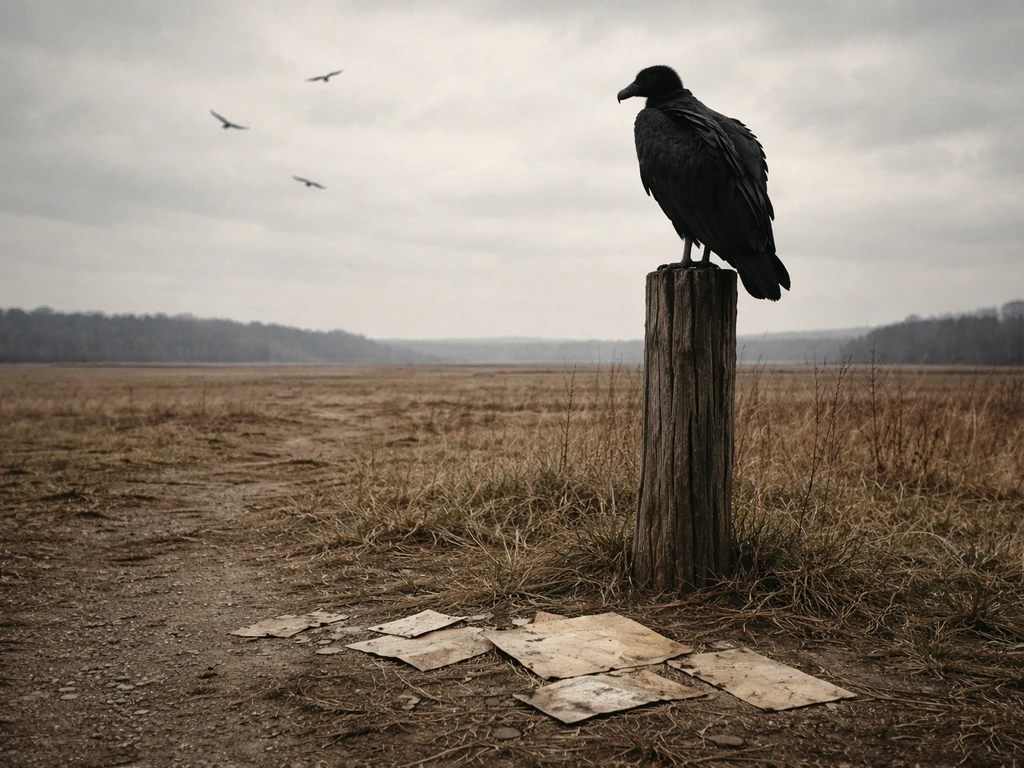
The origin of "dirty bird" as an expression isn't traceable to a single coining moment, which is pretty typical for folk slang. The underlying logic is simple: birds associated with filth, scavenging, or low behavior have been part of English insult vocabulary for centuries. Calling someone a bird that pecks at garbage or rolls in mud was a natural way to signal that they operated below respectable social standards. That conceptual thread runs through all the uses, from the literal vulture label to the bawdy-person connotation.
The regional American use referring to vultures is probably among the oldest documented senses. DARE records it as a genuine vernacular term used in parts of the United States to describe scavenging birds, which fits neatly with the broader pattern of using bird names to categorize behavior or character.
The Wild Turkey bourbon connection likely emerged organically from drinking culture, where colorful nicknames for bottles are common. Wild Turkey is a large, ungainly bird associated with rural American landscapes, and calling it the "dirty bird" added a kind of rough-and-ready charm to what is actually a premium spirit. Master of Malt also notes Wild Turkey’s droll nicknames, including “The Dirty Bird.” the “dirty bird” added a kind of rough-and-ready charm. By the time Jimmy Russell was talking publicly about the brand, "dirty bird" was already part of the lexicon for regular Wild Turkey drinkers.
The Atlanta Falcons' Dirty Bird dance gave the phrase its biggest mainstream cultural moment. During the Falcons' surprise 1998 season, Jamal Anderson's touchdown dance went viral in the pre-social-media sense: it was everywhere on sports television, mimicked by fans in the stands, and covered by national sports media. A 2006 New Yorker piece specifically mentions the dance alongside the phrase's "scuzzy connotations," which shows how even journalists writing about unrelated topics understood the term as carrying multiple layers simultaneously. That sports connection is still active today, and it widened the phrase's reach well beyond the American South.
How to figure out what it means from context
The surrounding context is almost always enough to nail down which meaning is in play. Here are some typical sentence setups and what they're pointing to.
| Example sentence or setting | Most likely meaning |
|---|---|
| "You're such a dirty bird," said with a laugh after someone tells a joke | Playful insult for someone being crude or cheeky |
| "Pour me two fingers of the dirty bird" | Wild Turkey bourbon |
| "He did the Dirty Bird in the end zone" | Atlanta Falcons touchdown dance |
| "I'm thinking dirty bird for dinner tonight" (Australian context) | KFC fried chicken |
| "The dirty birds were circling the field" (rural, older American writing) | Vultures |
| "Dirty Bird" as a venue, truck, or brand name (Australia) | Fried chicken restaurant/food concept |
In written contexts like a novel, song, or online post, pay attention to tone first. If the author is describing someone's behavior with exasperation or affection, you're in interpersonal-slang territory. If there's alcohol, a bar setting, or Southern American atmosphere, the bourbon nickname is the safer read. If there's a football game or sports highlight framing, the Falcons dance is almost certainly the reference. And if the text is clearly Australian and involves food, KFC or a fried-chicken concept is the obvious call. In r/AskAnAustralian, commenters note that Australians commonly use “KFC” as “dirty bird.” KFC or a fried-chicken concept.
Where people get confused with other bird slang
"Dirty bird" gets mixed up with a few related expressions that are worth knowing separately. "Dirt bird" is a closely related phrase (different by just one letter) but it tends to carry a heavier negative weight, pointing more squarely at someone considered low-class or contemptible, with less of the playful edge that "dirty bird" can have. If you've come across that one and want more detail, it has its own full treatment elsewhere on this site.
"Bad bird" and "naughty bird" overlap with the cheeky/misbehaving sense of "dirty bird" but neither has the same cultural baggage. If you’re trying to figure out what “naughty bird” means, it generally overlaps with the cheeky misbehaving sense but can shift depending on context. They tend to be lighter in register, often used toward children or pets in a scolding-but-affectionate way, whereas "dirty bird" usually implies adult behavior or a more loaded behavioral history.
"Bang bang bird gang" is a completely different phrase from hip-hop and street culture that doesn't carry any of the same connotations. The word "bird" does double duty in slang across many subcultures, so seeing it in a phrase doesn't automatically mean you're dealing with the same register as "dirty bird."
The Australian context adds another layer of potential confusion. If someone references a "dirty bird" documentary or a "dirty bird" ibis, they may be talking about the Australian White Ibis, which is colloquially called the "bin chicken" and is the subject of at least one Australian media production titled "Dirty Bird." That's a non-slang usage that's entirely literal (the bird genuinely digs through garbage bins), and it shouldn't be read as a comment on anyone's character or as a food reference.
Finally, "the Dirty Bird Society" is a distinct phrase that functions more like a proper noun, referring to a named group or brand rather than using the phrase as freestanding slang. If you encounter it capitalized, treat it as a specific organization or cultural identifier rather than the general expression.
How to use or respond to "dirty bird" in real life
If you want to use the phrase yourself, the interpersonal-slang meaning works best in casual, already-comfortable social settings where mild irreverence is welcome. Calling a friend a "dirty bird" after they say something outrageous lands as affectionate ribbing. Using it in a formal context, a workplace email, or around people you don't know well risks coming across as either confusing or inappropriate, because the phrase has enough sexual and crude connotations that it reads as pointed without the cushion of an established relationship.
If someone calls you a "dirty bird" and you're not sure whether to take it as a compliment, a joke, or an insult, tone of voice and relationship are your best guides. If you also see the related phrase "bad bird meaning," the same tone and context checks will usually tell you whether it is a cheeky misbehavior label or something more literal. Said with a grin, it's almost certainly teasing. Said flatly or in the middle of an argument, it's functioning as a genuine put-down. Either way, it's not a phrase that typically demands a formal response. A laugh, a mock-offended look, or a simple "guilty as charged" are all appropriate depending on the dynamic.
If you've encountered the phrase in a specific text, song, book, or online post and you're trying to pin down the exact meaning, the fastest move is to look at three things: the geographical or cultural context (American South, Australian, sports-related, bar-related?), the tone (jokey vs. sharp?), and whether any specific brands, teams, or recognizable references appear nearby. Those three signals will resolve the ambiguity in almost every case. And if the source is from the Urban Dictionary ecosystem specifically, that version of the phrase tends to lean heavily toward the crude or sexual definition, sometimes with meanings that are more explicit than the everyday casual use, so factor that in if your source is crowd-sourced slang documentation. In many cases, people first encounter the term through Urban Dictionary, which can emphasize the slang meaning as well as the crude or sexual interpretation Urban Dictionary ecosystem.
The bottom line: "dirty bird" is a flexible, layered piece of language with a genuine history. It's not random internet slang, and it's not a single fixed insult. Knowing the spread of meanings it covers, and knowing how to read the context it appears in, means you'll never be left guessing when you run into it again.
FAQ
Is “dirty bird” ever appropriate to use at work or in a formal email?
Not usually. In most casual settings it works as teasing or a mildly risqué character jab, but in workplace or formal settings it can read as crude or sexually suggestive. If you are unsure, treat it like an insult until you have a clear friend-to-friend tone, or ask a neutral follow-up like “What do you mean by that?”
How can I tell when “dirty bird” is a nickname for something (not an insult)?
If it is followed by something brand, team, or food related, it is probably not about someone’s personality. Examples to watch for are Wild Turkey in alcohol contexts, Falcons in sports highlights, or KFC and fried-chicken talk in Australian or food-heavy writing. When those anchors are present, “dirty bird” points to the specific reference rather than general behavior.
If someone calls me a “dirty bird,” how do I decide if it’s a joke or a real insult?
A quick “tone check” helps, but also watch the setting and audience. Teasing among close friends, especially after an outrageous joke, often signals affection. If it is said during an argument, by a stranger, or while criticizing behavior, it functions more like a put-down. Humor is usually supported by facial expression, timing, and conversational warmth.
Does “dirty bird” mean something worse on the internet than in real life?
Yes. Online, the meaning can drift more crude than what you would hear in everyday conversation. If you encountered it through crowd-sourced slang sites, the definition may include explicit sexual or highly offensive versions. The safest approach is to cross-check the source context, and assume the least charitable meaning until you see clear clues.
What word clues in the surrounding sentence are the best at disambiguating “dirty bird meaning”?
Because the phrase can refer to multiple things, the strongest tell is “adjacent reference words.” Look for nearby mentions of alcohol, a football play, a specific bird, or Australian food. If the sentence is about a person’s conduct without those anchors, it is likely the interpersonal slang meaning.
What’s the difference between “dirty bird” and “dirt bird” (spelling matters)?
“Dirt bird” is usually harsher and more contempt-focused, while “dirty bird” often keeps a bit of mischievous or cheeky energy. If you mix them up, the emotional tone can flip. When you’re quoting, double-check spelling to avoid accidentally changing the insult’s severity.
How is “dirty bird” different from “bad bird” or “naughty bird”?
“Dirty bird” can overlap with “bad bird” or “naughty bird,” but those usually do not carry the same strong cultural anchors. If the text mentions Wild Turkey, Falcons, or KFC, “dirty bird” likely means those references. If it is mainly about “misbehaving,” then “naughty bird” is often more child or pet scolding, while “dirty bird” more often implies adult-level behavior.
Could “dirty bird” be about an actual bird (not slang), especially in Australia?
You might be seeing a literal bird use rather than slang if the context is about Australian wildlife, documentaries, or specific bird behavior like rummaging through bins. In that case, it is not a comment on a person at all. Check whether the “dirty bird” phrase appears alongside bird species, locations, or animal descriptions.
What should I do if I see “Dirty Bird” capitalized in a sentence?
If it is capitalized, or appears like a name, treat it as a proper noun. Phrases that look like “the Dirty Bird Society” are more likely a group or brand than the general insult or the sports or bourbon references. In those cases, the capital letters and article-like phrasing are the key signals.
What’s the best way to respond if someone uses “dirty bird” at me?
If you want to respond, you can mirror the implied register. For teasing, a light comeback like “Maybe, but only because you started it” keeps it playful. For a sharp put-down, keep it short and boundary-focused, for example “I’m not sure why you said that,” instead of escalating. Either way, avoid turning it into a debate about slang definitions in the moment.
Next Article
Thirst Reckoned Bird North Meaning Explained and Decoded
Decode the riddle phrase thirst reckoned bird north meaning: idioms, symbolism, and direction clues to find likely inten