When someone uses "bird" sexually in a relationship context, they most often mean the penis. That's the most common Urban Dictionary-style meaning you'll run into, especially in messages like "she grabbed my bird" or "she found out I have a big bird." But "bird" is genuinely slippery slang: depending on tone, region, and what's around it in a sentence, it can also refer to an attractive woman, a person of low character, or even oral sex (via the phrase "bird migration"). Urban Dictionary’s “Bird lady” entry shows how “bird” can function as person-directed slang rather than necessarily indicating sex, which can contribute to misinterpretation blank" rel="noopener noreferrer">bird is genuinely slippery slang. The word alone isn't enough to pin down the meaning. Context does the heavy lifting.
What Does Bird Mean Sexually in a Relationship

What "bird" usually means sexually in relationship slang
The most widely cited sexual meaning of "bird" on Urban Dictionary is a straightforward euphemism for the penis. If you want a quick baseline, many people start by checking an Urban Dictionary definition for what the term means in that exact context, since meanings can vary by wording and tone aku bird meaning urban dictionary. If you want to see examples, the Urban Dictionary entries often break down the different senses of bird slang (including sexual meanings) by context. Example entries use it in sentences like "Dude, she grabbed my bird!!!" where it's clearly standing in for male genitalia. A second sexual usage treats "bird" as a label for a woman, sometimes complimentary ("a beautiful, majestic creature"), sometimes derogatory ("a woman of low quality and standards"). These two meanings live in the same slang ecosystem but point in completely different directions, so misreading the tone can cause real confusion.
There's also a relational layer. "Bird in a cage" is a specific Urban Dictionary entry that describes an extremely attractive woman who's already in a relationship. In that usage, "bird" carries a sexual or desirability charge, but it's about status and jealousy rather than a sex act. When someone says this about a person's partner, it's often flirtatious or envious rather than explicit.
Common Urban Dictionary definitions and how they differ
Urban Dictionary isn't one dictionary. It's a pile of crowd-sourced entries that don't always agree, and "bird" has accumulated several distinct meanings across different pages and contributors. Here's how the main ones break down:
| UD Definition | Example or Usage | What it actually signals |
|---|---|---|
| Penis / male genitalia | "She grabbed my bird" | Explicit body part reference; most common sexual meaning |
| Attractive woman (positive) | "She's a bird" (admiring tone) | Complimentary person-label; flirtatious rather than explicit |
| Woman of low standards (negative) | "She's a bird" (dismissive tone) | Derogatory person-label; tone and context shift the meaning entirely |
| Bird in a cage | "She's a bird in a cage" (about someone's partner) | Desirable but taken; jealousy/attraction framing, not an explicit act |
| Bird migration | "They were doing bird migration" | Explicit: slang for oral sex, especially in Australian teen slang |
| Bird penis (compound slang) | Meme-style, intentionally absurd explicit jokes | Deliberate shock humor; unlikely to appear in sincere conversation |
The big takeaway here is that "bird" as a standalone word covers a huge range. The person-label uses (attractive woman, low-standards woman) don't imply a sex act is being discussed. The body-part and "bird migration" uses do. Compound phrases like "big bird" or "grabbed my bird" are the strongest signals that the penis meaning is in play.
How "bird" shows up in real texts and conversations
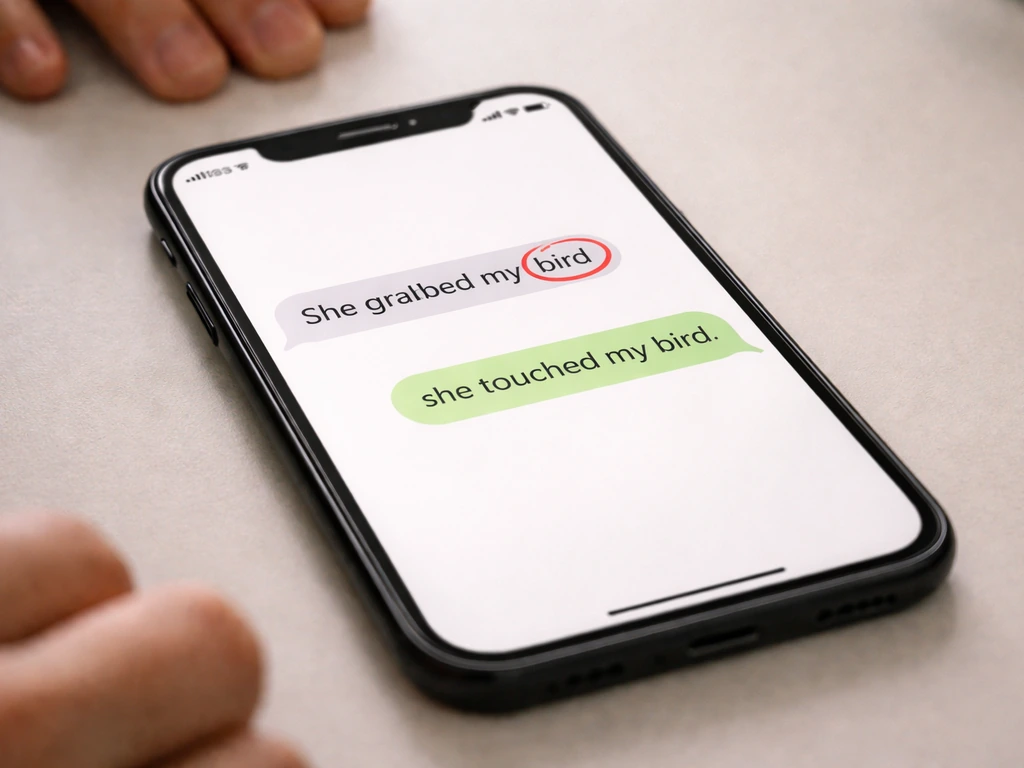
The surrounding words are almost always the deciding factor. Here are some realistic scenarios and what they're most likely pointing to:
- "She grabbed my bird" or "she touched my bird": an action verb plus a body-part context makes this almost certainly the penis meaning.
- "She found out I have a big bird": size-comparative language plus "big" is another strong penis signal.
- "She's a bird" with no other context: could be a compliment or an insult. Tone in voice, or emoji in text, is the only way to tell.
- "She's a bird in a cage": relational framing about someone being taken; sexual charge is about attractiveness and jealousy, not a direct sex act.
- "They were on some bird migration stuff": explicit oral sex reference, especially if the speaker is from Australia or using Australian-influenced slang.
- "That girl is such a bird": without other cues, this lands somewhere between "attractive" and "problematic," depending on the relationship dynamic of the speakers.
Pay attention to whether the statement is directed at a person or at a body. Person-directed statements ("she's a bird") tend to be labels about attractiveness or character. Body-directed statements ("grabbed my bird") almost always mean the penis. That single distinction clears up most of the confusion.
Consent, boundaries, and what to do when you're not sure
If someone uses "bird" in a sexual way and you're not sure where they're going with it, that ambiguity itself is a cue to pause. Consent isn't a one-time checkbox. According to sexual health organizations including RAINN and Planned Parenthood, it's an ongoing conversation, and the moment something feels unclear is exactly when checking in matters most. If a partner is using slang you don't fully understand, you don't have to interpret it correctly before you respond. You're allowed to stop and ask.
If the language made you uncomfortable, whether it was too explicit too fast, or whether it felt derogatory (like being called "a bird" in a dismissive way), that discomfort is valid and worth addressing. McGill University's consent guidelines put it plainly: when cues are ambiguous, there's a good chance you need to check in verbally, and the best way to know if consent is present is to ask. That works both ways. If someone used language you didn't like, you can say so directly. If you used language that landed wrong, asking how it landed is the respectful move.
How to ask what someone meant without making it awkward

Asking for clarification about slang doesn't have to be a dramatic conversation. The goal is just to understand what the person actually meant so you can respond honestly. Here are a few ways to approach it depending on the situation:
- Keep it casual and direct: "Hey, what did you mean when you said that?" works fine for a text exchange. You don't need to explain yourself for asking.
- Use an "I" statement if it felt off: "I wasn't sure how to take that" opens the door without putting the other person on the defensive right away.
- Be specific rather than vague: "When you said 'bird' did you mean...?" is faster and less awkward than a general "that was weird."
- Pick a low-pressure moment: if it came up in the middle of something intense, it's okay to circle back later when things are calmer. Rushed clarifications often get muddled.
- Don't assume bad intent until you know more: the same word can come from a completely different place depending on who's saying it and where they grew up.
GoodRx's expert-reviewed communication tips for talking about sex include a point that's worth keeping in mind here: don't make assumptions. That cuts both ways. Don't assume someone was being inappropriate if you're not sure, and don't assume they were being harmless if the context felt off. Just ask.
Bird slang that has nothing to do with sex
Not every use of "bird" in slang is sexual, and mixing these up can create unnecessary awkwardness. "Bird" as British slang for a young woman is a classic example. If you came across the phrase "sly bird" on Urban Dictionary, it helps to check the exact entry text and the surrounding sentence for the intended meaning sly bird meaning on Urban Dictionary (sly bird meaning urban dictionary). In the UK, calling someone your "bird" is roughly equivalent to calling them your girlfriend or a woman you fancy, and it carries no explicit meaning. Someone using British slang in a relationship context might say "my bird" the way an American would say "my girl." That's not a sexual euphemism; it's a regional idiom.
"Bird" also appears in drug slang (a kilogram of cocaine), in internet meme culture as "birb" (an affectionate, non-sexual spelling for cute bird images), and in classic phrases like "the bird is the word" that reference a 1960s pop song rather than anything sexual. The related slang term "j-bird" can be a term of endearment for an attractive woman whose name starts with J, which sits in the complimentary-label category rather than the explicit-act category.
Expressions like "a bird in the hand," "flip the bird," and "early bird gets the worm" are idioms with no sexual meaning at all. If you're on a site exploring bird language and symbolism more broadly, it's worth knowing that the same word that means "penis" in one slang community can mean "girlfriend" in another, or "drug quantity" in another, or just a literal animal in a third. Regional origin, speaker age, and conversational context are everything.
Practical next steps to figure out what was actually meant
If you landed here trying to decode something someone said to you, here's a straightforward process to work through it:
- Look at what was around the word. Was there a body-directed action (grabbed, touched, saw)? That points to the penis meaning. Was it a person-directed label ("she's a bird")? That points to the attractiveness or character meaning.
- Consider who said it and where they're from. British speakers using "bird" for a girlfriend or partner is not the same as American slang for penis. Australian speakers using "bird migration" are likely referencing oral sex.
- Notice the tone. A compliment and a dismissal can use identical words. "She's a bird" said admiringly versus said derisively lands in completely different places.
- If you're still unsure, ask. A simple "what did you mean by that?" is always available to you, and anyone who reacts badly to a sincere question is giving you useful information about them.
- If the language made you uncomfortable, say so. You don't have to figure out the exact meaning to set a boundary. "I didn't like the way that was phrased" is a complete sentence.
- If the conversation was moving toward sexual territory and you're not sure how you feel about that, it's fine to slow down. Planned Parenthood's guidance is clear: if someone seems reluctant or uncomfortable, the conversation about comfort levels needs to happen before anything advances.
The bottom line is that "bird" in relationship and sexual slang usually means the penis when it's body-directed, and means something about a person's attractiveness or character when it's person-directed. The phrase "bird migration" is its own specific term for oral sex. Everything else requires context to interpret. When in doubt, ask. It's the fastest way to get from confusion to an actual answer, and it's the foundation of any decent relationship dynamic anyway. If you're also wondering how much the term costs to look up on Urban Dictionary, it helps to check how the site charges for access how much is a bird urban dictionary.
FAQ
If my partner texted “she found out I have a big bird,” is it always about the penis?
It is strongly likely to be a penis euphemism, because “have a big bird” and similar phrasing are usually body-directed. Still, verify by asking one calm question, like “When you say ‘bird,’ what part of that do you mean?” rather than guessing.
What does it mean if someone calls you “a bird” but not your body parts?
Person-directed “a bird” is usually about attractiveness or character, it can be complimentary or derogatory depending on tone and other words. If the tone feels dismissive or degrading, address it directly and ask what they mean by the label.
How can I tell whether “bird in a cage” is sexual or just jealousy/flirting?
“Bird in a cage” is most often about an extremely attractive woman who is already taken, the subtext is desirability and jealousy. It is usually not describing a sex act, but you should still ask if they are talking about someone’s partner in a flirtatious way versus making explicit comments.
Is “bird migration” always oral sex, and how should I respond if I’m uncomfortable?
Yes, in slang that phrase is typically used as a term for oral sex. If you feel uncomfortable, you do not need to “go with it,” you can set a boundary, for example “I don’t like that wording, can we keep things respectful,” and ask what they mean.
Can “bird” mean something totally different depending on where the speaker is from?
Yes. For example, in British slang, “bird” can be roughly like “girlfriend” or “a woman I fancy,” which is not explicitly sexual. The fastest check is the surrounding sentence (is it labeling a person as a partner, or describing something someone has grabbed or migrated?).
What if the slang shows up in a way I cannot separate “person” versus “body,” like “my bird is dangerous”?
That’s an ambiguity trap. When the sentence does not clearly point to a body part or a person-label, assume you might be wrong and ask. A simple “What did you mean by ‘bird’ there?” avoids turning a misunderstanding into an argument.
Is it okay to ask for clarification even if the conversation already feels heated?
Yes, and it is often the best move. You can pause the moment and ask what they mean, consent and comfort are not optional. Keep it brief and neutral so it does not feel like blame, for example “Can you clarify what you mean by ‘bird’?”
Could “bird” be used for drugs or something non-sexual?
It can. In some slang communities, “bird” is used for drug quantities, so context matters. If it appears near numbers, weight, or distribution talk, do not treat it as sexual slang and consider it a red-flag topic for safety and boundaries.
What are the most common mistakes people make when interpreting “bird” in texting?
The biggest mistake is treating “bird” as one fixed meaning. People often assume it is always sexual, or they overcorrect and treat it as a compliment, both of which can cause awkwardness. Look for body-directed verbs (grabbed, have, under my control) versus person-directed statements (she’s a bird, my bird as a girlfriend).
I’m worried my partner used derogatory language. How do I bring it up without sounding accusatory?
Focus on impact and ask for meaning. You can say, “When you called me a ‘bird,’ I felt talked down to. What did you mean by that?” This invites clarification while also making your boundaries clear.
Does “bird” ever mean literal animals in relationship chat?
It can, especially if they are talking about a pet, a joke, or a meme. If there are no relationship or body cues, treat it as literal or playful and ask if it’s about an animal before assuming sexual intent.
Sly Bird Meaning: Urban Dictionary and Real Usage Guide
Learn sly bird meaning and how Urban Dictionary defines it, with examples to spot literal vs slang uses fast.